
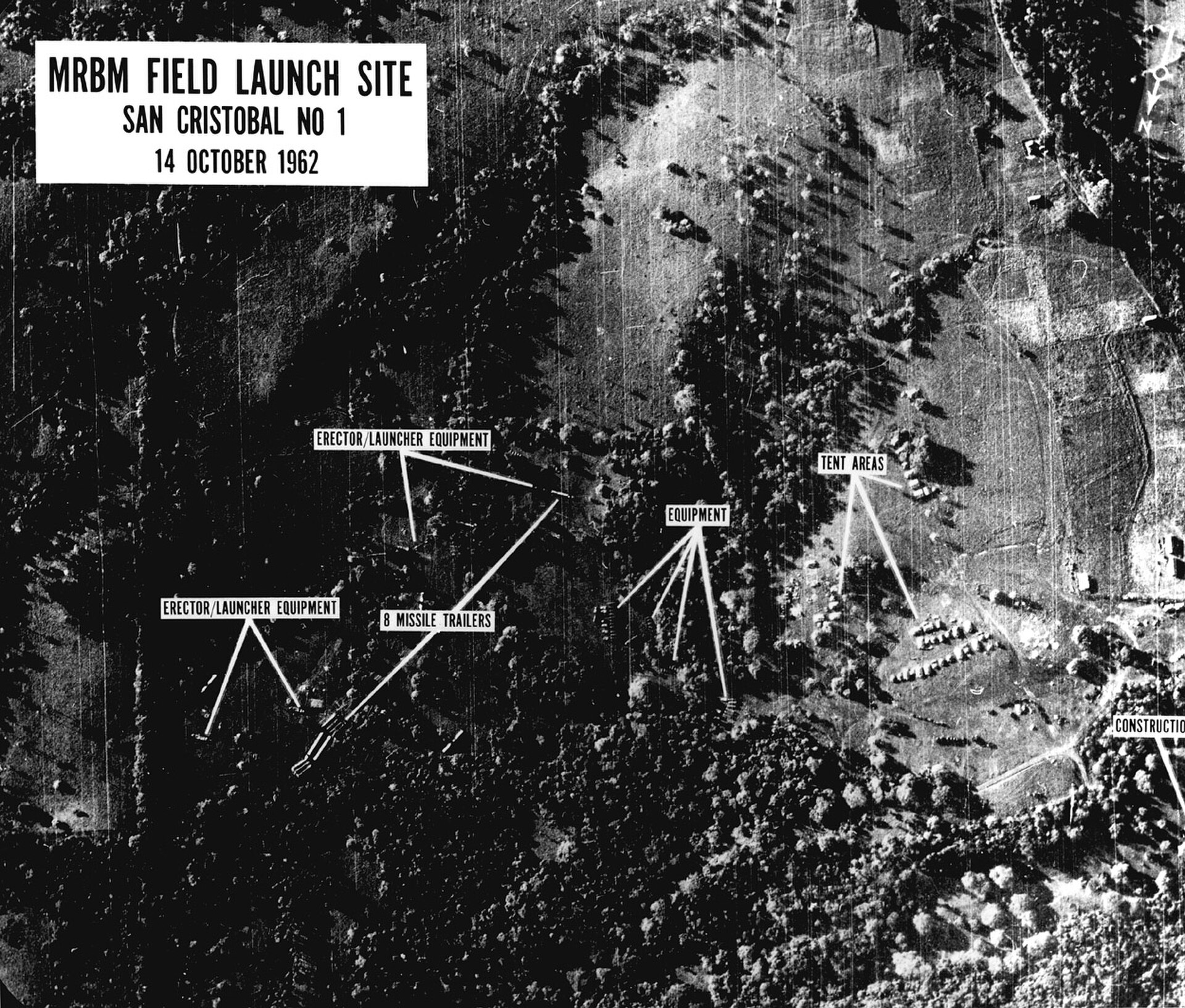
At dawn on October 14, 1962, a single grey Lockheed U-2 reconnaissance aircraft crossed the Yucatán Channel at 72,500 feet and turned north into Cuban airspace. Piloted by United States Air Force Major Richard S. Heyser, the high-altitude spy plane spent roughly six minutes over western Cuba with its high-resolution cameras running. Flying high enough to leave no contrail in the morning sky, Heyser completed his photographic run without being engaged by the Soviet-supplied air-defense forces positioned below.
Heyser landed safely at McCoy Air Force Base in Florida after a seven-hour flight from Edwards Air Force Base in California. His reconnaissance film was rushed to Washington, D.C., where photo interpreters at the National Photographic Interpretation Center examined the 928 photographs captured during those brief minutes over the island. The images revealed Soviet SS-4 medium-range ballistic-missile sites under construction near San Cristóbal—offensive missile capability capable of reaching much of the United States mainland.
When President John F. Kennedy was briefed on the morning of October 16, the discovery set in motion the Cuban Missile Crisis. For thirteen days, the United States and the Soviet Union stood at the brink of nuclear war, as Washington demanded the removal of the missiles and Moscow resisted. Major Heyser’s brief October 14 mission became one of the most consequential reconnaissance flights in history, transforming a routine aerial intelligence run into the catalyst for the most dangerous confrontation of the Cold War.
