
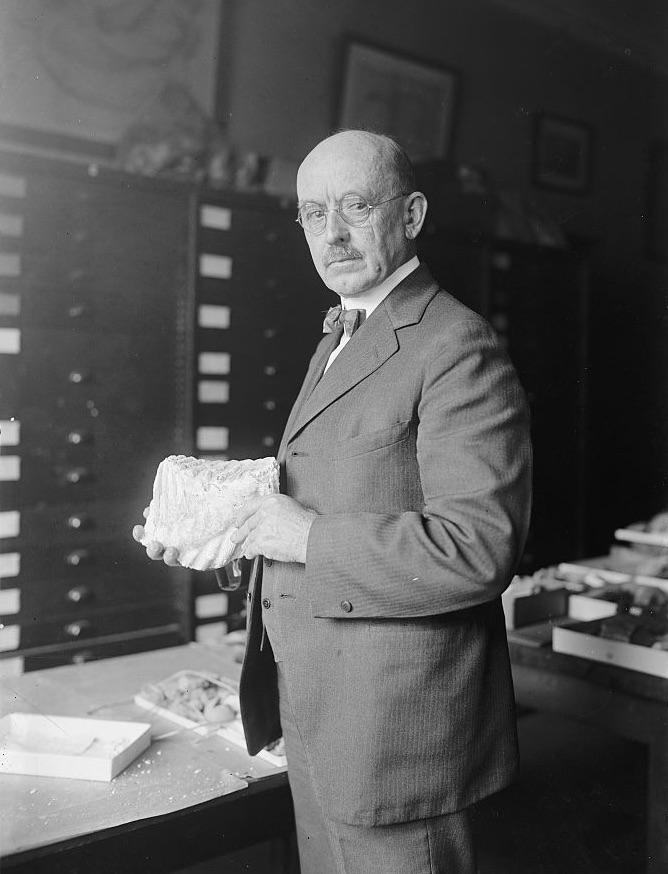
On October 6, 1924, a photograph captured Dr. James Williams Gidley examining a massive fossil tooth from an extinct elephant. Gidley, a vertebrate paleontologist at the Smithsonian’s United States National Museum in Washington, D.C., devoted his career to the study and preparation of fossil mammals. The image survives in the Library of Congress’s National Photo Company Collection, a major archive of Washington news photography from the early twentieth century.
Gidley joined the United States National Museum in 1905, became Custodian of Fossil Mammals in 1908, and served as Assistant Curator from 1912 until his death in 1931. His research ranged broadly across fossil mammals, but he was especially recognized for work on North American fossil horses and on Pleistocene remains in Florida. Earlier in his career, he collected important horse fossils, including Equus scotti in Texas and the three-toed horse Neohipparion in Nebraska.
The photograph conveys the material reality behind paleontology: a specimen of extraordinary size held close for patient inspection. Gidley’s work combined field collecting, fossil preparation, identification, and museum curation—activities that helped transform fragmentary remains into scientific evidence and public displays. He also supervised work at Cumberland Bone Cave in Maryland between 1912 and 1916, where excavations documented a diverse assemblage of extinct Pleistocene mammals.
More than a portrait of a scientist at work, the 1924 image records a period when museum paleontology brought the prehistoric past into public view. Gidley’s legacy rests not on a single spectacular object, but on decades of research, collecting, and curatorial work that strengthened the Smithsonian’s record of North American fossil mammals.