
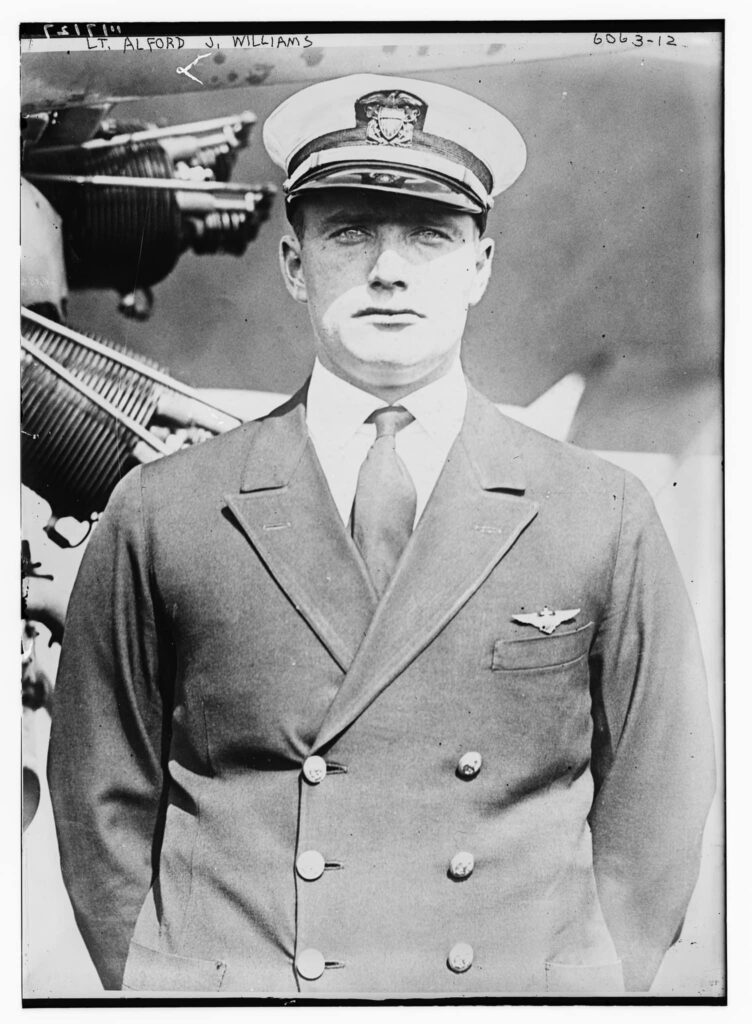
On October 6, 1923, Lieutenant Alford J. Williams of the United States Navy won the Pulitzer Trophy Race at St. Louis, Missouri, one of America’s premier aviation speed contests. Flying a new Curtiss R2C-1 racing biplane, Williams averaged 243.67 miles per hour over the four-lap, 124.4-mile course—a performance that set new recognized speed marks over 100 and 200 kilometers. The result crowned a remarkable U.S. Navy showing: Navy pilots occupied the race’s first four places.
The Pulitzer competition, funded by publisher Ralph Pulitzer, had become a prominent proving ground for high-speed aircraft design in the early aviation era. The 1923 race brought together specially built military racers whose designers sought every advantage in engine power, cooling, weight reduction, and aerodynamic streamlining. Williams’s Curtiss R2C-1, powered by a Curtiss D-12 engine, represented this push toward lower drag and ever-higher speeds.
Williams’s victory placed him at the forefront of American speed flying. In early November at Mitchel Field on Long Island, he and fellow Navy pilot Lieutenant Harold J. Brow each pursued the world airspeed record in R2C-1 racers. Brow briefly held the mark, but Williams reclaimed it on November 4, reaching 266.59 miles per hour over the measured course.
The 1923 Pulitzer victory remains a landmark of interwar aviation: an event in which military pilots and engineers used racing to test the limits of engines, airframes, and human skill. Williams’s 243.67-mph run captured a moment when the pursuit of speed was rapidly reshaping what aircraft could achieve.