
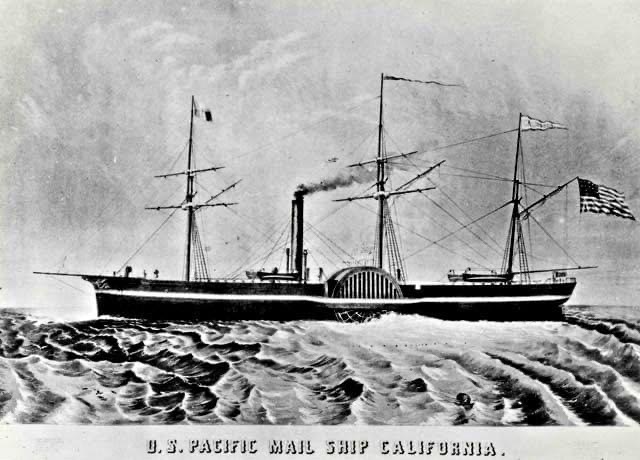
On the evening of October 6, 1848, the pioneering U.S. steamship California cleared New York Harbor and began an extraordinary maiden voyage to the Pacific Coast. Built by noted New York shipbuilder William H. Webb for the Pacific Mail Steamship Company, the 199-foot side-wheel steamer had been constructed to help establish government-contracted mail, passenger, and freight service between Panama, San Francisco, and Oregon.
Her journey from New York to the Pacific was itself a major undertaking. The California steamed south through the Atlantic, crossed the equator, and reached Rio de Janeiro on November 2, where she replenished supplies. She then continued south through the Strait of Magellan—not around Cape Horn—before turning northward into the Pacific and making calls at ports including Valparaíso and Callao. She reached Panama on January 17, 1849.
By then, news of the gold discovery at Sutter’s Mill had transformed the voyage. Hundreds of would-be miners were stranded on the Isthmus, urgently seeking transportation to California. Although designed to carry about 210 passengers, the California left Panama heavily overcrowded, carrying more than 360 gold seekers by some accounts after over 700 people competed for berths.
The steamship entered San Francisco Bay on February 28, 1849, 145 days after leaving New York. Her arrival made her the first Pacific Mail steamer to reach San Francisco and helped inaugurate the steamship route that accelerated the Gold Rush migration, linking the Atlantic world, Panama, and the rapidly growing American West.