
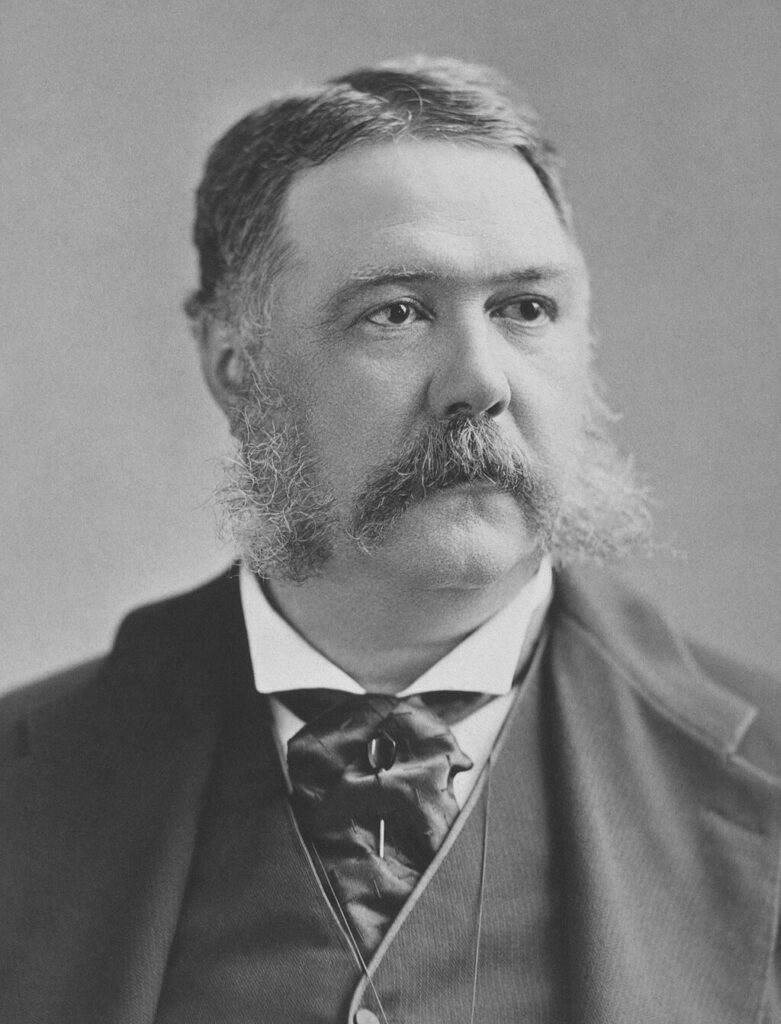
Born on October 5, 1829, in Fairfield, Vermont, Chester A. Arthur would eventually become the twenty-first president of the United States. Before the presidency, however, he built a reputation for capable and conscientious public service during the Civil War. Governor Edwin D. Morgan initially placed Arthur on the state’s military staff as engineer-in-chief. Arthur later served as inspector general and, in July 1862, became quartermaster-general of New York.
The position placed him at the center of New York’s enormous war effort. Arthur supervised the provision of uniforms, equipment, shelter, transportation, and other supplies for troops entering Union service, while also helping administer the state’s military logistics. His department handled an extraordinary volume of work; in one four-month period in 1862, Arthur reported that it had clothed, equipped, and transported sixty-eight infantry regiments, two cavalry battalions, and four artillery battalions to the seat of war.
Contemporaries praised Arthur for efficiency, close attention to contracts, and personal honesty. Later accounts emphasized that he insisted on proper standards from suppliers and resisted the personal favors that could create even an appearance of compromised judgment. Those accounts should be understood in part as admiring political biography, but they reflect the reputation Arthur acquired from his wartime administration: that of a careful, reliable official trusted with large public responsibilities.
Arthur expressed that concern for public trust in a frequently quoted remark: “If I had misappropriated five cents, and on walking downtown saw two men talking on the street together, I would imagine they were talking of my dishonesty.” Whether remembered verbatim or not, the line captures the image Arthur and his supporters attached to his Civil War service—an administrator determined to remain beyond suspicion.
His record as quartermaster-general is therefore more than a preliminary footnote to his presidency. It helped establish the administrative reputation that later made him a consequential figure in New York Republican politics and, ultimately, a national officeholder.
