
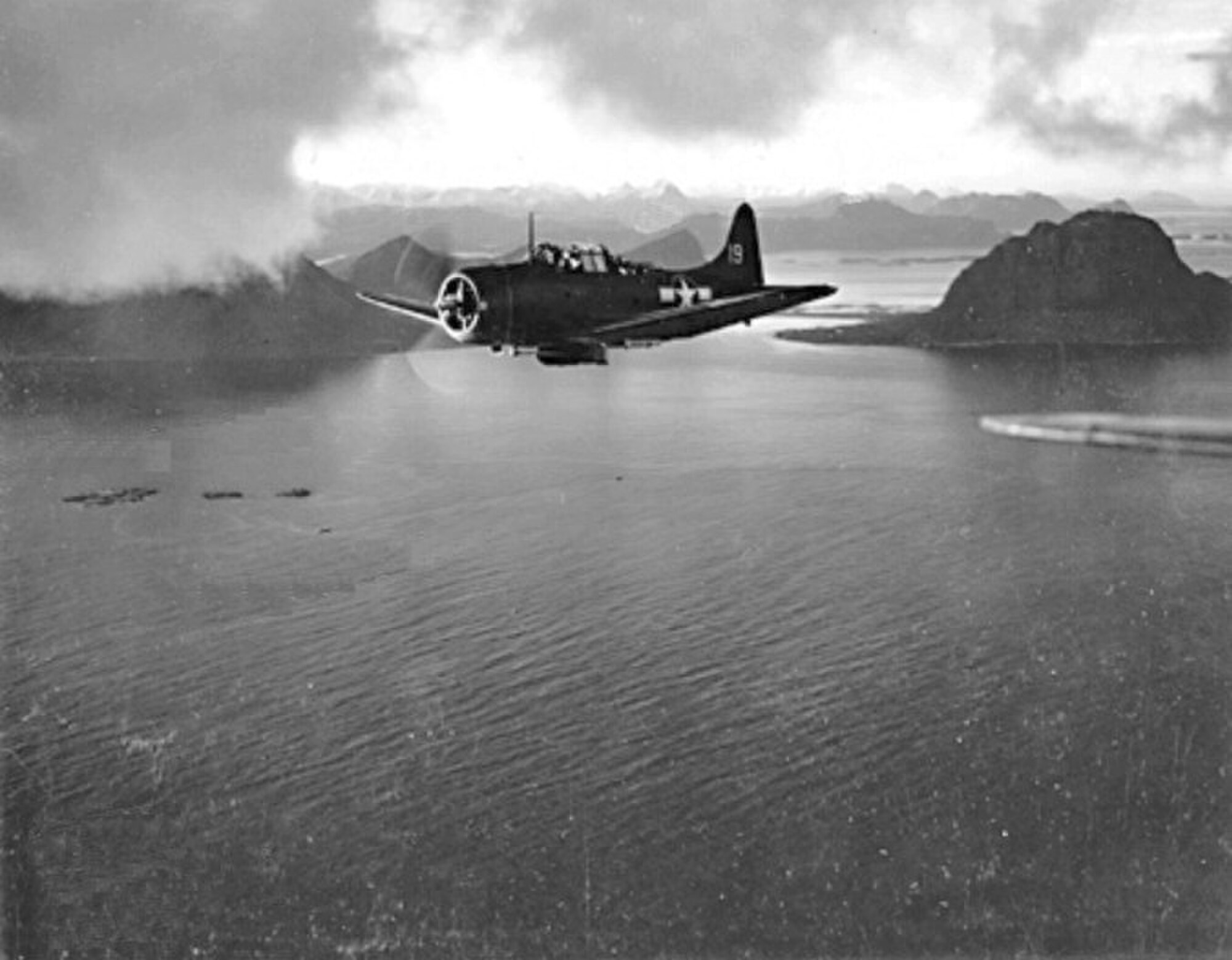
On 4 October 1943, aircraft from the U.S. Navy carrier USS Ranger (CV-4), operating with the British Home Fleet, struck German shipping off occupied Norway in Operation Leader. The raid was the only U.S. Navy carrier operation conducted in northern European waters during World War II—and the service’s only carrier operation in the Arctic Circle.
Before dawn, the Allied task force reached its launch position off Norway’s Vestfjord undetected. Ranger then launched the Northern Attack Group: 20 Douglas SBD Dauntless dive bombers escorted by eight Grumman F4F Wildcat fighters. Their mission was to attack German shipping in and near the port of Bodø, an important link in the coastal traffic supporting Germany’s occupation of Norway and its access to Scandinavian iron ore.
Approaching the coast at low altitude, the Dauntless crews caught their targets by surprise despite anti-aircraft fire. Four SBDs and two Wildcats broke away to attack the 8,056-ton freighter La Plata, which was badly damaged and subsequently beached to prevent it from sinking. Other aircraft struck a German convoy, severely damaging a tanker and a troop transport while sinking merchant vessels in the area.
Operation Leader demonstrated that American carrier aircraft could operate effectively in the demanding conditions of the Norwegian Sea and Arctic region. More immediately, the raid disrupted German coastal shipping at a time when the movement of cargo along Norway’s long, rugged coast remained important to the German war effort. It was a notable tactical success—and a rare example of U.S. carrier aviation striking the Axis in northern Europe.
Image credit: Archival U.S. Navy photograph of a VB-4 Douglas SBD Dauntless near Bodø, Norway, 4 October 1943, via Wikimedia Commons/public-domain U.S. Navy imagery.
