
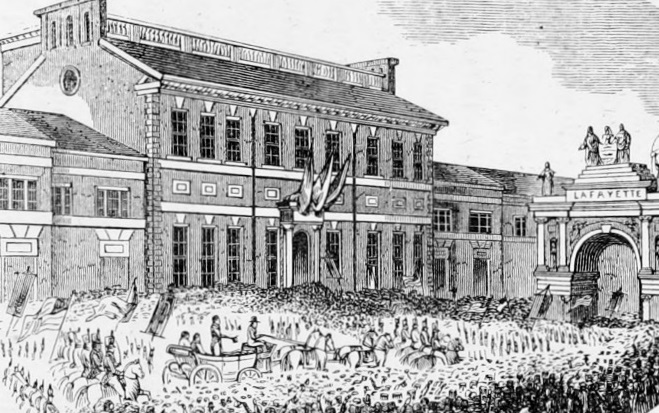
Philadelphia’s streets swelled with gratitude and grandeur on September 28, 1824, as General Lafayette entered the city as a living emblem of liberty—embraced by one of the places that had helped bring the American Revolution to life.
After returning to France in 1781, before the American Revolution had formally ended, the Marquis de Lafayette soon found himself drawn into the upheaval of his own country. A committed advocate of constitutional liberty, he played a central role in the early French Revolution: he helped draft the Declaration of the Rights of Man and of the Citizen and commanded Paris’s National Guard. Yet his moderation, and his belief that liberty could coexist with a constitutional monarchy, placed him in dangerous conflict with the Revolution’s increasingly radical forces.
In 1792, Lafayette fled France after being denounced by the revolutionary government. Captured first by Prussian troops and later held by Austria, he endured nearly five years of imprisonment, much of it in the fortress of Olmütz. During his captivity, George Washington and other American friends sought his release; Washington personally appealed to European rulers on Lafayette’s behalf. Lafayette was freed in 1797 and eventually returned to France, where he remained a steadfast liberal opponent of authoritarian rule. During the Bourbon Restoration, he served in the Chamber of Deputies and continued to champion civil liberties.
By 1824, Lafayette had become a singular bridge between the revolutionary ideals of the Old World and the New. President James Monroe invited the aging hero to undertake a grand American tour—his first return in more than forty years. Across the country, he received an extraordinary outpouring of public affection.
Lafayette arrived in the Philadelphia area on September 27, where he was honored at Holmesburg and lodged overnight at the Frankford Arsenal. The next morning, September 28, he made his formal entrance into the city amid a 100-gun salute and a vast procession that included militia units, Revolutionary War veterans, public officials, tradesmen, and citizens from across the region. The celebration culminated at Independence Hall.
For Philadelphians, Lafayette’s return was more than a parade. It was a moment of national remembrance: an emerging generation of Americans could see, honor, and celebrate one of the last living leaders of the age that had secured their independence.
Image via Wikimedia Commons; no known copyright restrictions.
