
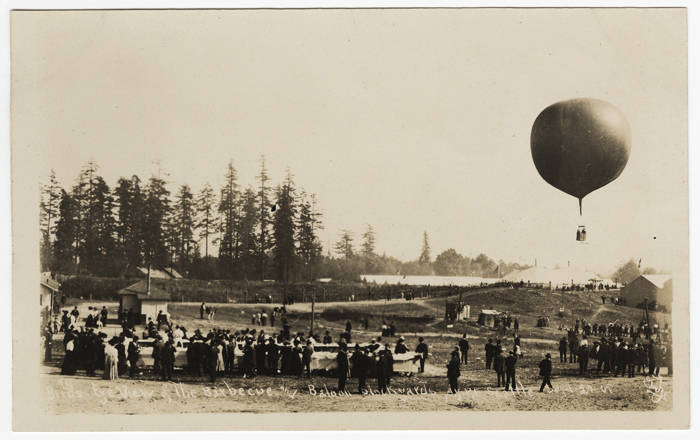
On September 27, 1909, visitors to Seattle’s Alaska-Yukon-Pacific Exposition gathered for an unusually vivid display of public celebration: a large community barbecue accompanied by a hot-air-balloon exhibition. Smoke and activity from the pit-roasting joined the spectacle overhead, creating a scene that blended old communal traditions with the thrill of new technology.
The Alaska-Yukon-Pacific Exposition was more than a summer attraction. Like other world’s fairs of the early twentieth century, it was designed to promote a vision of progress—one shaped by industrial growth, expanding transportation networks, scientific display, architecture, and the commercial ambitions of its host region. Seattle used the fair to present itself as a rising Pacific port and an important gateway to Alaska, the Yukon, and the broader markets of the Pacific world.
For many visitors, the fair offered experiences that would have been difficult or impossible to encounter in daily life. Large-scale public events turned the exposition into a shared civic stage, where thousands could dine, socialize, see elaborate exhibits, and witness forms of entertainment associated with modernity. Balloon ascensions, in particular, retained an aura of daring and wonder in an age when powered flight was still new and aviation captured public imagination.
The barbecue added a different kind of appeal. Rather than treating progress as something confined to machinery or displays, the gathering made the fair a social occasion: a place where civic pride could be expressed through food, crowds, and collective celebration. The contrast is striking—traditional pit-roasting on the ground, airborne spectacle above—but it captures much of what made such expositions memorable. They promised visitors not only a glimpse of the future, but also the pleasure of experiencing that future together.
Image via Wikimedia Commons; public domain.
