
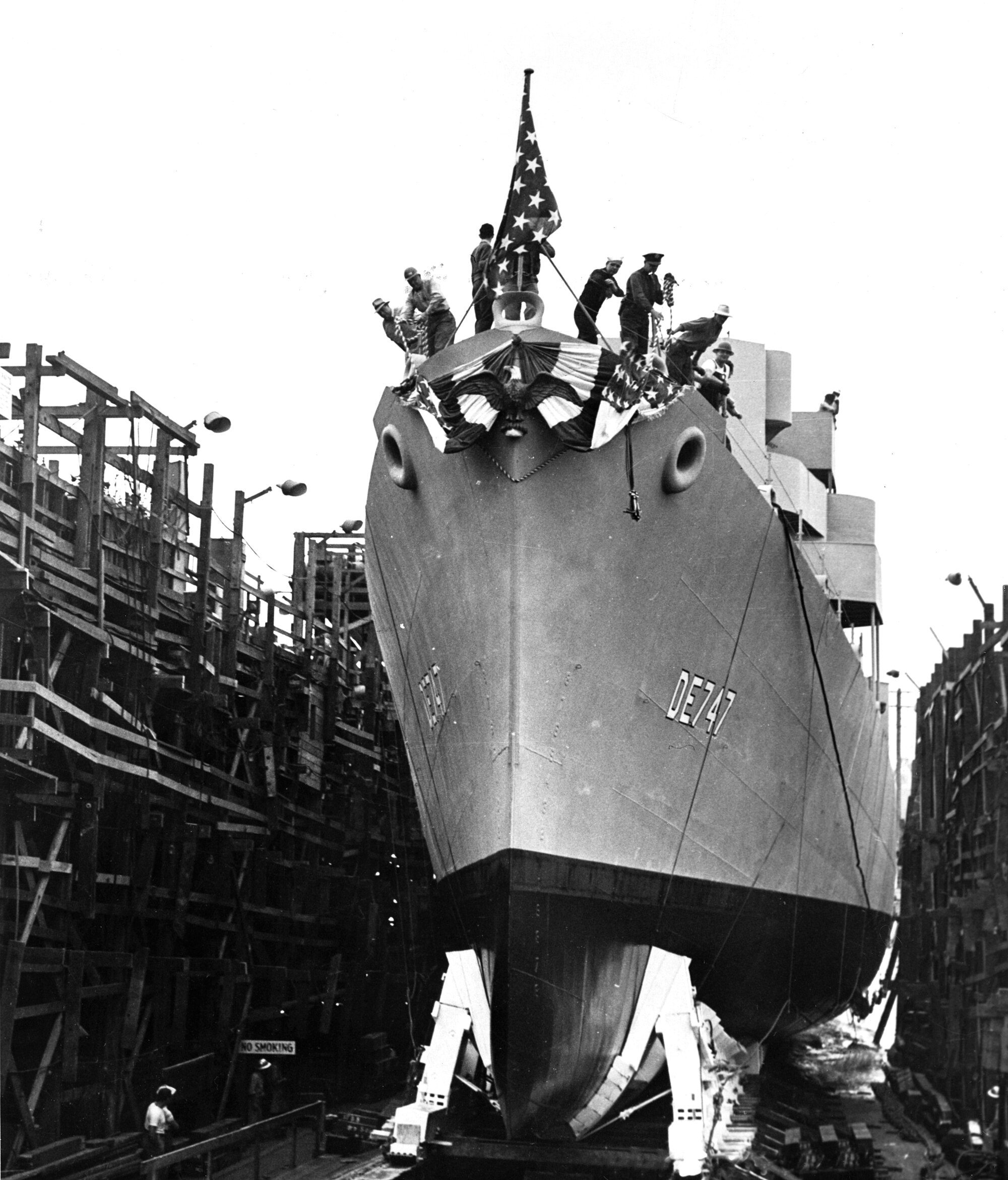
On September 26, 1943, the U.S. Navy destroyer escort USS Bright (DE-747) was launched at the Western Pipe and Steel Company yard at San Pedro, California. Sponsored by Mrs. Miriam Engle Bright, widow of the ship’s namesake, Lieutenant (j.g.) Graham Paul Bright, the vessel reflected the enormous industrial mobilization of the American home front during World War II. Lieutenant Bright, a Navy fiscal specialist serving with the naval government of Guam, was killed during the Japanese invasion of the island on December 10, 1941.
A Cannon-class destroyer escort, Bright was built for the demanding work of protecting convoys and hunting submarines. Compared with fleet destroyers, destroyer escorts were smaller and more economical vessels, optimized for escort duty and antisubmarine warfare rather than high-speed operations with major battle fleets.
Commissioned on June 30, 1944, Bright served in the Pacific. She escorted the SS John B. Floyd from San Diego to Hawaii, trained in Hawaiian waters, and then joined Task Group 12.3 for a series of hunter-killer operations based around the Hawaiian and Marshall Islands between late 1944 and April 1945.
Her most dramatic action came during the Okinawa campaign. On May 13, 1945, while screening transports against submarines, Bright engaged a low-flying Japanese Mitsubishi A6M5 “Zeke.” Although her gunfire damaged the plane and tore away part of its wing, the aircraft continued its suicide attack and crashed into the ship’s fantail. The resulting bomb explosion caused severe damage, including the loss of steering control, destruction of the after engine room, and flooding in several compartments. Despite the damage, her crew kept the ship afloat and even helped engage another attacking aircraft shortly afterward.
Bright survived the war and was decommissioned in 1946. For her World War II service, she earned one battle star.
(Image: Launch of USS Bright at San Pedro, California, via Wikimedia Commons, public domain.)
