
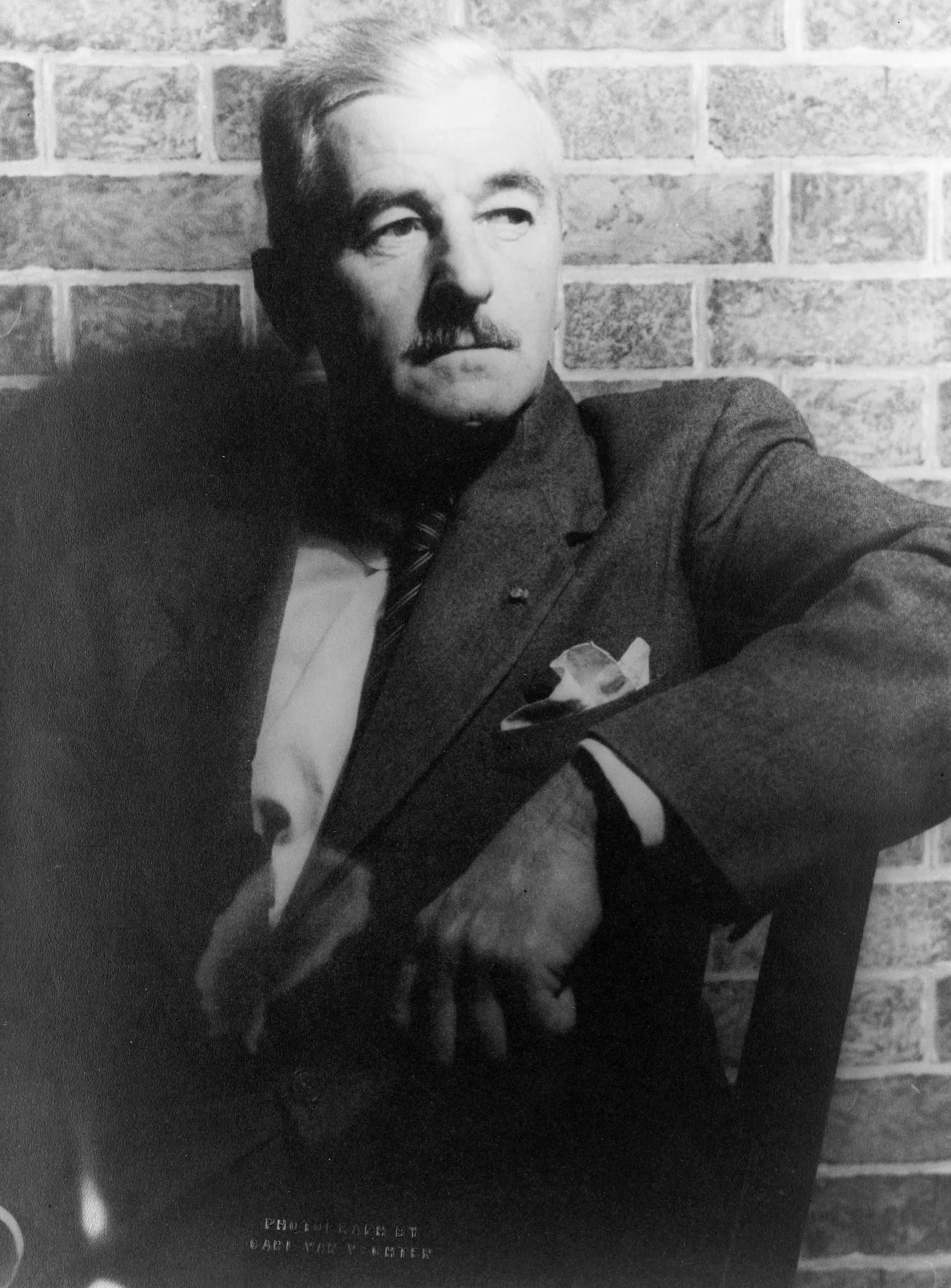
On September 25, 1897, William Cuthbert Falkner—who later adopted the spelling William Faulkner—was born in New Albany, Mississippi. The future novelist, short-story writer, and Nobel laureate became one of the defining voices of twentieth-century American literature, renowned for his complex stream-of-consciousness style and for Yoknapatawpha County, the fictional Mississippi setting that united much of his work.
Faulkner’s rise was far from conventional. He did not graduate from high school and later attended the University of Mississippi without earning a degree; during his studies, he received a D in English. Before his literary reputation brought greater financial security, Faulkner also worked intermittently in Hollywood as a screenwriter. He contributed to numerous films, including the Howard Hawks productions To Have and Have Not (1944) and The Big Sleep (1946).
Through enduring works such as The Sound and the Fury (1929), As I Lay Dying (1930), and Absalom, Absalom! (1936), Faulkner explored memory, family, violence, racial injustice, and the changing social order of the American South. In 1949, he received the Nobel Prize in Literature “for his powerful and artistically unique contribution to the modern American novel.” His work remains central to American letters and continues to shape writers and readers around the world.
Image: Library of Congress, via Wikimedia Commons; public domain in the United States.
