
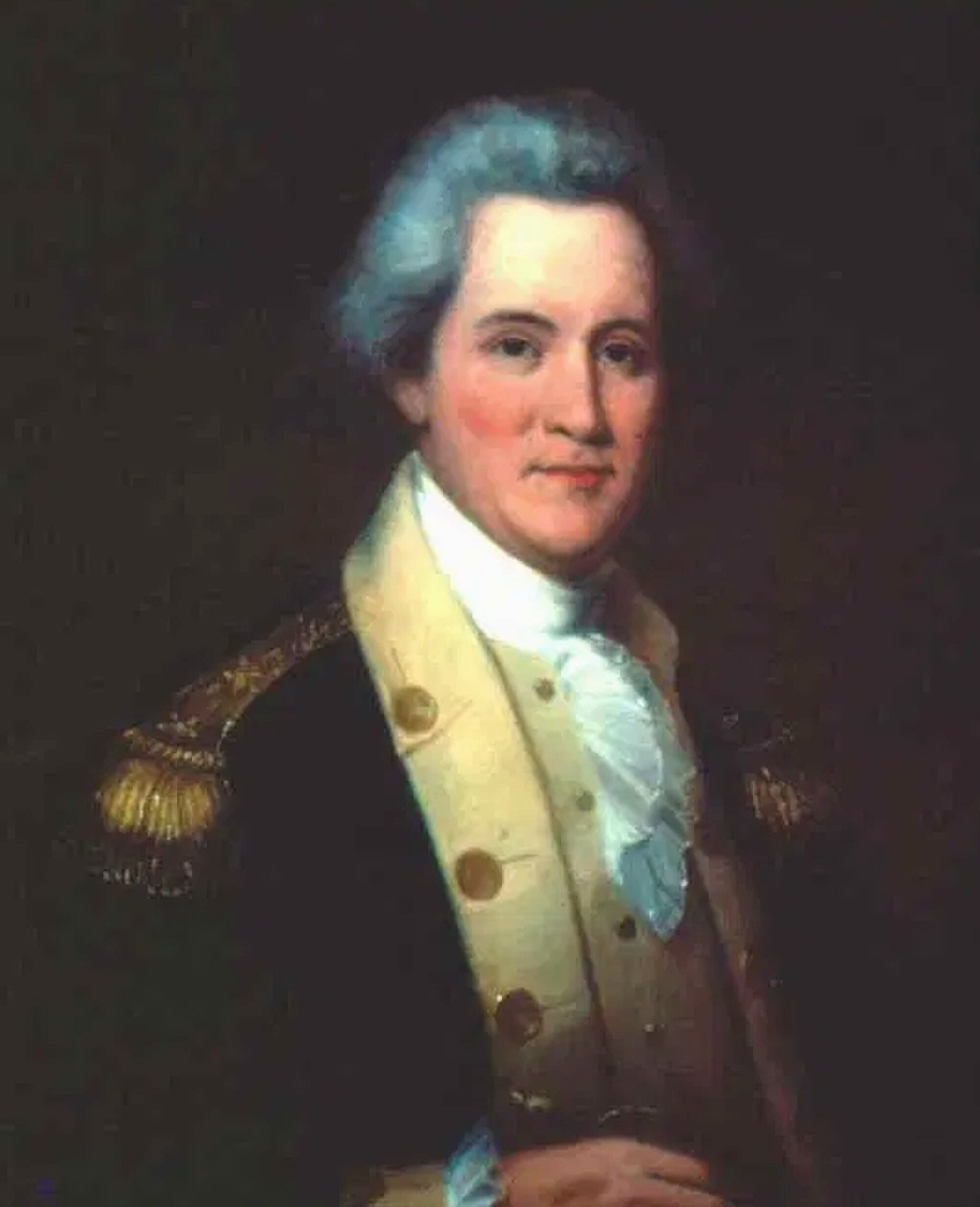
On September 24, 1815, legendary frontier commander and Tennessee statesman John Sevier died at age seventy while serving on a commission to establish the boundary between Georgia and Creek territory in the Alabama Territory. His life embodied the turbulent expansion, warfare, and institution-building that shaped the early American trans-Appalachian frontier.
Sevier rose to prominence during the American Revolution as one of the leaders of the frontier “Overmountain Men” at the decisive Patriot victory over Loyalist forces at the Battle of Kings Mountain in 1780. After the war, he became the only governor of the short-lived and unrecognized State of Franklin, an effort by western North Carolina settlers to create a separate state. When Tennessee entered the Union in 1796, Sevier’s extraordinary regional popularity helped make him the new state’s first governor. He ultimately served six two-year terms, from 1796 to 1801 and again from 1803 to 1809.
Sevier’s family life also reflected the hardships of the early frontier. He and his first wife, Sarah Hawkins, had ten children before her death shortly after the birth of their final child. He later married Catherine “Bonny Kate” Sherrill, with whom he had eight more children.
Initially buried near Fort Decatur, Alabama, Sevier’s remains were reinterred in Knoxville in 1889, where his grave became a lasting memorial to one of Tennessee’s foundational political figures.
Image via Wikimedia Commons; no known restrictions.
