
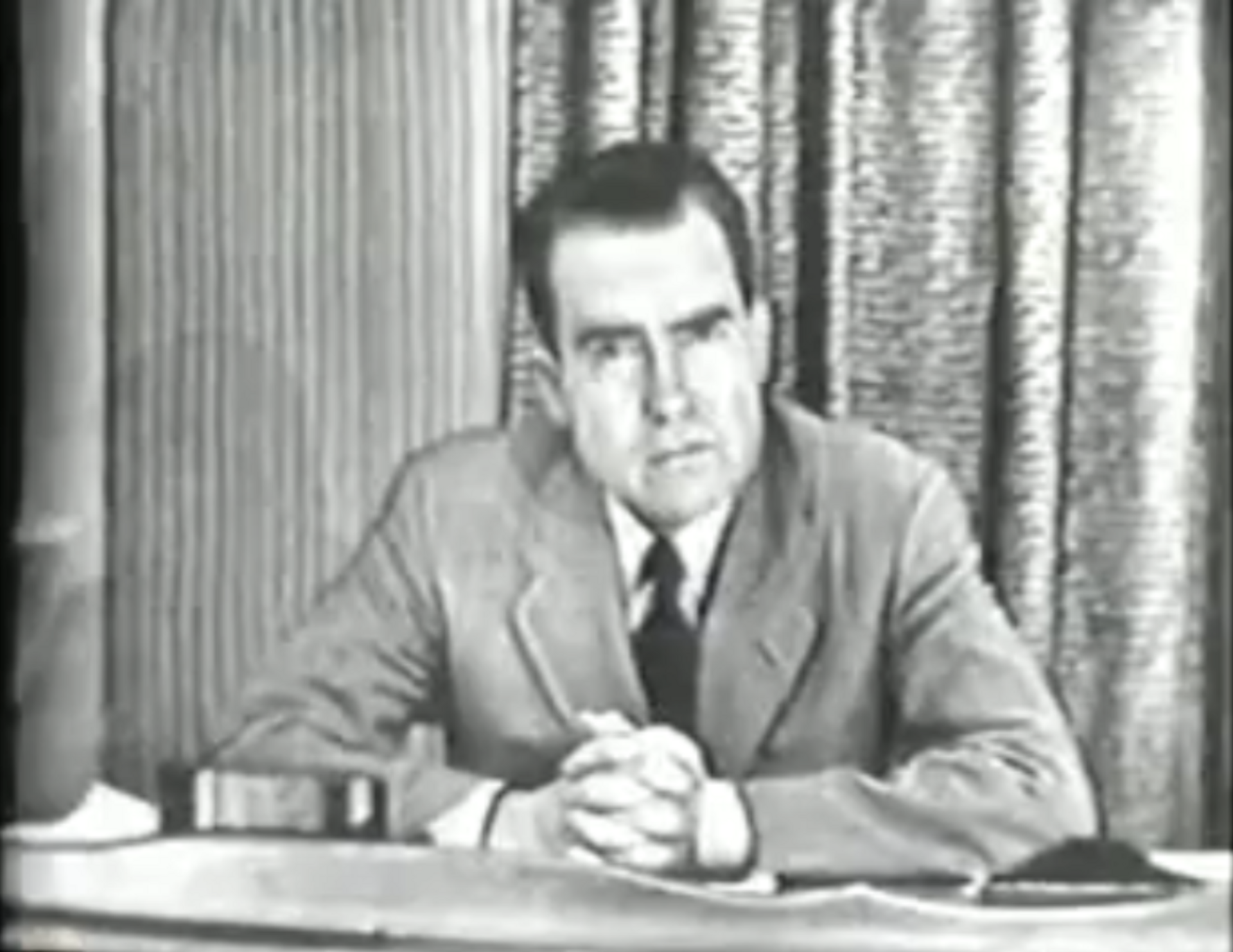
On September 23, 1952, California Senator and Republican vice-presidential nominee Richard M. Nixon delivered a nationally broadcast, half-hour address from Los Angeles that became known as the “Checkers speech.” Nixon was under intense pressure to leave General Dwight D. Eisenhower’s presidential ticket after reports that supporters had maintained a privately funded account to reimburse his political expenses. Critics portrayed the account as a secret or improper fund; Nixon denied that it had been secret or used for his personal benefit, citing an independent audit and legal opinion.
Speaking directly to the public rather than solely through party leaders, Nixon offered unusually detailed disclosures about his family’s finances. He discussed his income, savings, mortgages, debts, and his modest lifestyle, including the line that his wife, Pat, did not own a mink coat but wore “a respectable Republican cloth coat.”
The speech acquired its name from Nixon’s discussion of one exception to his refusal to accept personal gifts: a black-and-white cocker spaniel that had been sent to his young daughters. He said that, regardless of criticism, the family would keep the dog because “the kids, like all kids, love the dog.”
An estimated 60 million Americans watched or heard the broadcast, making it one of the largest U.S. broadcast audiences of its time. It produced a substantial public response and helped Nixon retain his place on the Republican ticket. Eisenhower and Nixon went on to win the 1952 election.
The “Checkers speech” remains a major landmark in American political history. It demonstrated the growing ability of a national candidate to use television to bypass party intermediaries, present a carefully constructed personal image, and appeal directly to mass audiences during a political crisis. Although it did not by itself make television an unavoidable requirement for national leadership, it was an early and influential example of television’s expanding role in modern U.S. campaigns.
Image via Wikimedia Commons, public domain.
