
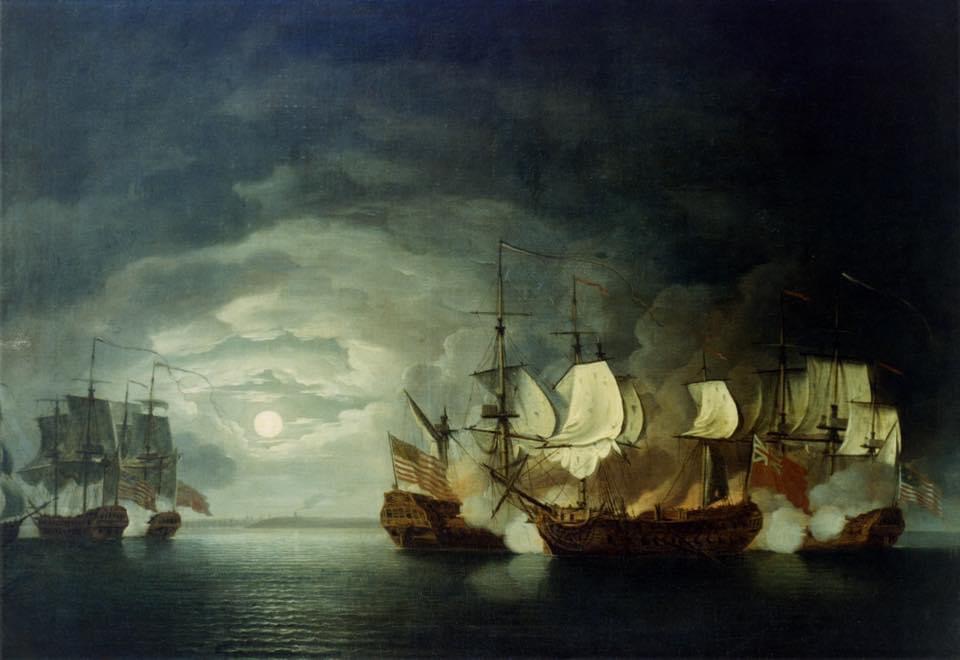
On September 23, 1779, Captain John Paul Jones led the Continental Navy warship Bonhomme Richard to a legendary victory over the British frigate HMS Serapis off Flamborough Head, England. Named for Benjamin Franklin’s Poor Richard’s Almanack, Bonhomme Richard was a former French merchant vessel converted for war—old, slow, and outmatched by the newer, more heavily armed Serapis.
Rather than withdraw, Jones closed with the British ship and fought a brutal, hours-long artillery duel. As darkness fell, the two vessels collided, became entangled, and were lashed together. Bonhomme Richard suffered catastrophic damage: its guns were silenced or destroyed, fires spread aboard, and water poured into the hull.
At one point, British captain Richard Pearson called across the ships to ask whether the Americans had surrendered. Jones gave the reply that became one of the most famous lines in U.S. naval history: “I have not yet begun to fight.”
The battle turned as American crewmen and Marines positioned high in the Bonhomme Richard’s own rigging maintained a deadly fire onto the open decks of the Serapis, culminating when a sailor dropped a grenade into a main hatch, igniting a massive explosion below. Chaos was compounded when the Alliance, one of Jones’s accompanying ships, arrived and erratically loosed broadsides that struck both combatants, adding to the damage on the American flagship. Facing catastrophic losses, Captain Pearson eventually struck his colors and surrendered.
Bonhomme Richard was too badly damaged to save and sank two days later. Jones and his crew transferred to the captured Serapis and sailed to the Dutch port of Texel. The victory was a major symbolic and diplomatic success for the young United States, demonstrating that the Continental Navy could challenge Britain on its own waters.
Image: “Bonhomme Richard closely engages HMS Serapis off Flamborough Head,” via Wikimedia Commons, public domain.
