
On September 22, 1692, eight people were hanged in Salem, Massachusetts, in the final executions of the Salem witch trials: Martha Corey, Mary Eastey, Alice Parker, Mary Parker, Ann Pudeator, Wilmot Redd, Margaret Scott, and Samuel Wardwell. They had been condemned by the Court of Oyer and Terminer, the special tribunal created during the crisis. Its willingness to credit spectral evidence—claims that an accused person’s spirit had harmed another—became one of the most troubling features of the proceedings.
These were the final executions, but not the end of the crisis or its human toll. Nineteen people were hanged during the Salem witch trials. Giles Corey was pressed to death after refusing to enter a plea, and five others died in jail.
Mary Eastey’s final petition remains one of the era’s most moving documents. Rather than simply begging for her own life, she appealed to the governor, judges, and ministers to prevent further injustice: “I Petition to your honours not for my own life,” she wrote, but, if possible, that “no more Innocent blood may be shed.”
Public confidence in the proceedings had already begun to fracture. Governor William Phips halted the Court of Oyer and Terminer’s work in October 1692, and the court was formally dissolved on October 29. No further executions followed. Later proceedings became more cautious, especially as the credibility of spectral testimony deteriorated.
Salem remains a lasting warning about what fear, communal pressure, and weak legal safeguards can do when accusation is treated as proof.
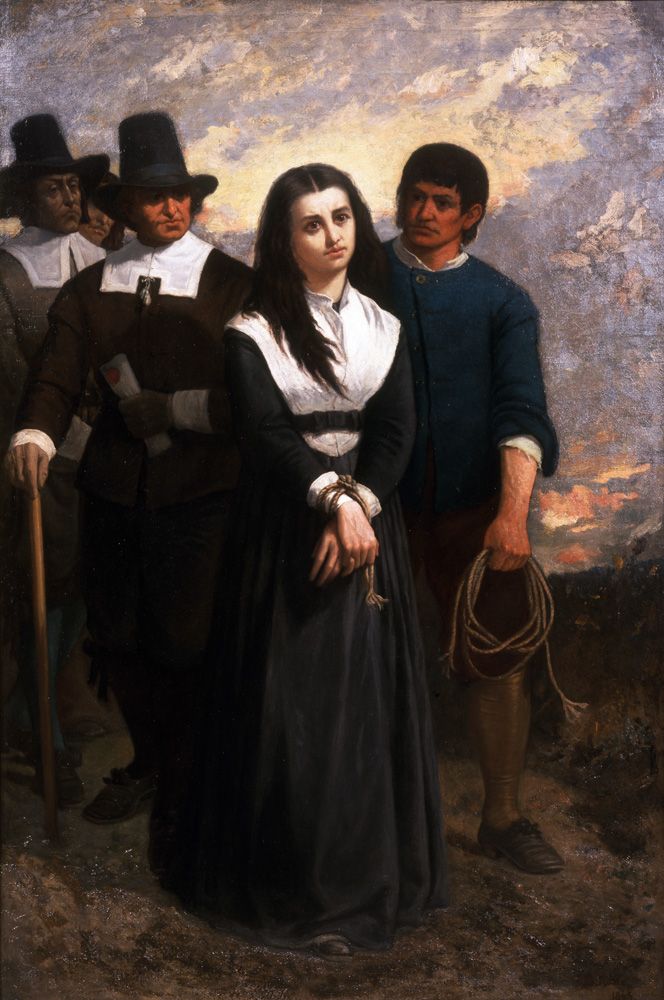
That warning has also been expressed through art. In Thomas Satterwhite Noble’s 1869 painting Witch Hill (The Salem Martyr), a young woman is portrayed as luminous and serene amid grim Puritan figures. The painting is a romanticized memorial rather than a literal portrait: Mary Eastey herself was a 58-year-old mother of seven when she was executed. Yet its emotional contrast captures the central tragedy of Salem—the human dignity of people destroyed by a process that failed to protect the innocent.
Image via Wikimedia Commons, public domain.
