
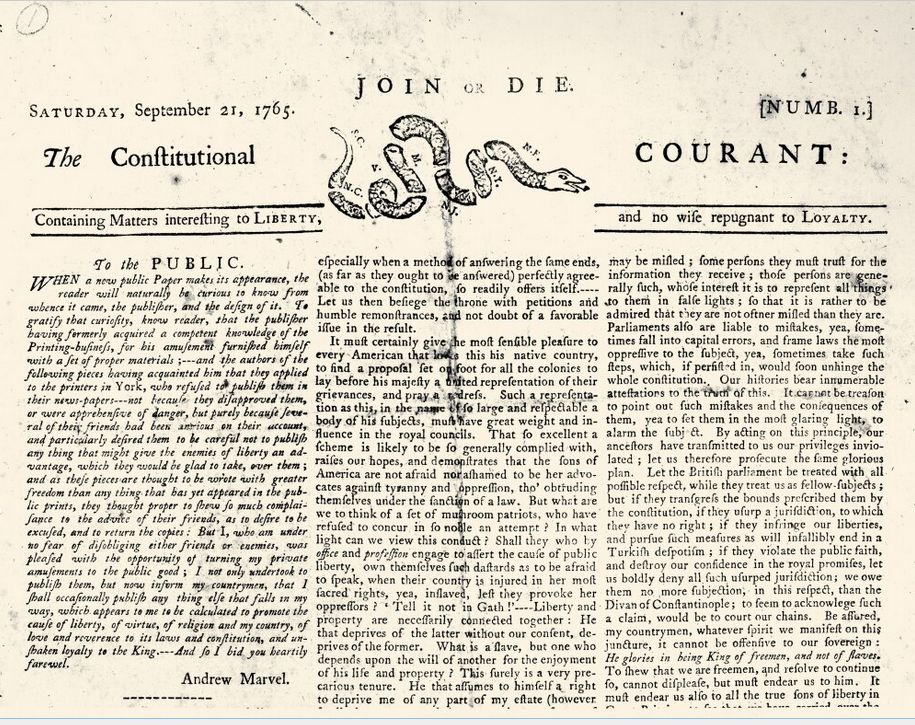
On September 21, 1765, a single-issue political tract styled as a newspaper, The Constitutional Courant, appeared in Woodbridge, New Jersey. Published under the pseudonym “Andrew Marvel”—identified by the Library of Congress as William Goddard—and printed on James Parker’s press, it was a fierce denunciation of Parliament’s Stamp Act. The act had been passed earlier that year and was due to take effect on November 1; it required stamped paper for newspapers and a broad range of legal and commercial documents, placing printers among those directly affected by the new tax.
Its masthead revived Benjamin Franklin’s “Join, or Die” image: a segmented snake representing the British colonies and regions in North America. Franklin had first published the woodcut in the Pennsylvania Gazette on May 9, 1754, amid calls for cooperation during the French and Indian War. The image’s original eight sections included New England as a single unit and seven other colonies or regions; it was not yet an emblem of thirteen united states.
In 1765, the image took on a sharper political purpose. Reprinted in the midst of the Stamp Act crisis, “Join, or Die” urged colonists to see that their defense of liberty depended on acting in concert. The point was practical as well as symbolic: colonies that protested separately could be isolated and pressured; colonies that coordinated could amplify their resistance.
That did not yet mean a settled demand for independence. The Courant presented its argument as compatible with loyalty to the Crown, even while attacking parliamentary taxation and defending colonial rights. But its use of the serpent helped make intercolonial unity a political necessity. In that sense, the image anticipated a central lesson of the revolutionary era: shared grievances could create shared action before they created a nation.
“Join, or Die”—again. First published by Benjamin Franklin in 1754, the segmented snake was among the earliest and most influential political cartoons in colonial America. In September 1765, The Constitutional Courant repurposed it against the Stamp Act, which had been enacted but would not take effect until November 1. The message was blunt: colonial liberties depended on colonial unity. Before revolution marched in open rebellion, it found one of its most durable emblems in black ink. Image via Wikimedia Commons
