
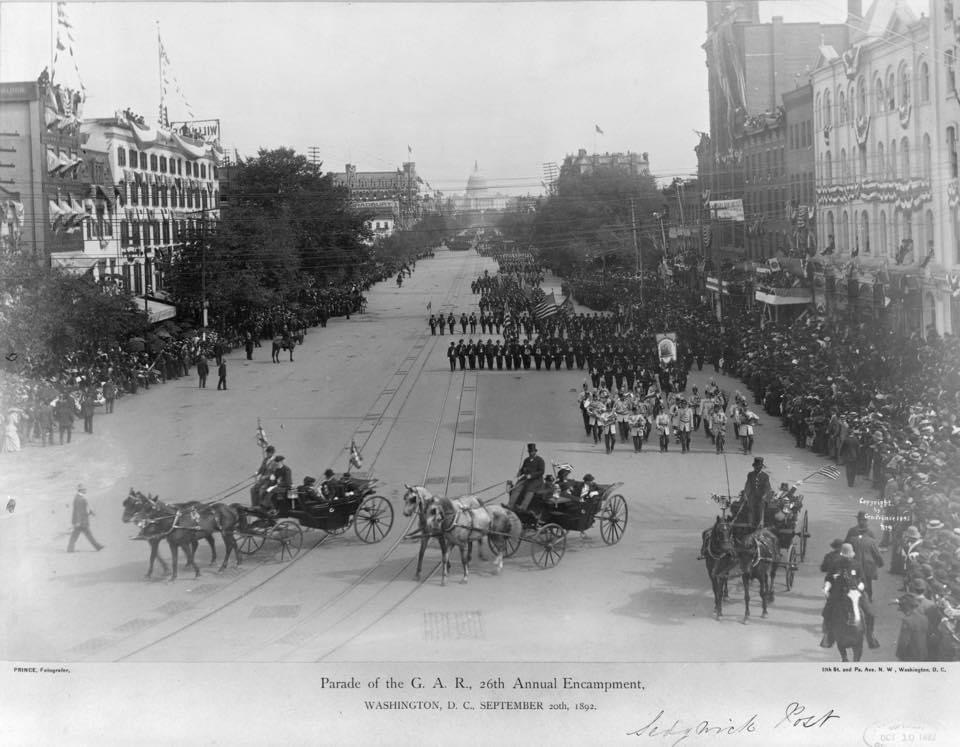
On September 20, 1892, Washington, D.C.’s avenues filled with Union Civil War veterans marching in the grand review and parade of the Grand Army of the Republic during its twenty-sixth national encampment. Veterans and their families traveled to the capital from across the former Union, turning the city’s broad thoroughfares into a public display of Civil War memory, comradeship, and national patriotism. The event program itself identified the day’s central feature as a “review and parade.”
Marching in organized columns beneath old regimental and national flags, G.A.R. members demonstrated that their shared wartime experience still carried civic and political force nearly three decades after Appomattox. The parade was more than a reunion: it made the veterans’ public identity visible to Washington crowds and reaffirmed the G.A.R.’s place as the nation’s most influential Union-veterans organization.
By the early 1890s, the G.A.R. had grown to more than 400,000 members and had become a formidable advocate for former Union soldiers, their dependents, and their communities. It pressed successfully for expanded federal pensions, while its posts also supported disabled veterans, widows, and orphans through charitable work. The organization also played a foundational role in the annual observance of Memorial Day: in 1868, G.A.R. commander-in-chief John A. Logan called on members to decorate Union war graves on May 30, helping establish the tradition then known as Decoration Day.
The 1892 Washington parade therefore captured a transitional moment. Its participants remained a potent political constituency, but they were also increasingly guardians of a war passing from lived experience into national remembrance. In that sense, the procession shows how ordinary citizen-soldiers turned wartime service into a lasting culture of commemoration, mutual aid, and veterans’ advocacy.
Image: “Parade of the G.A.R., 26th annual encampment, Washington, D.C.” – September 20, 1892. Photo by George Prince via Wikimedia Commons, public domain.
