
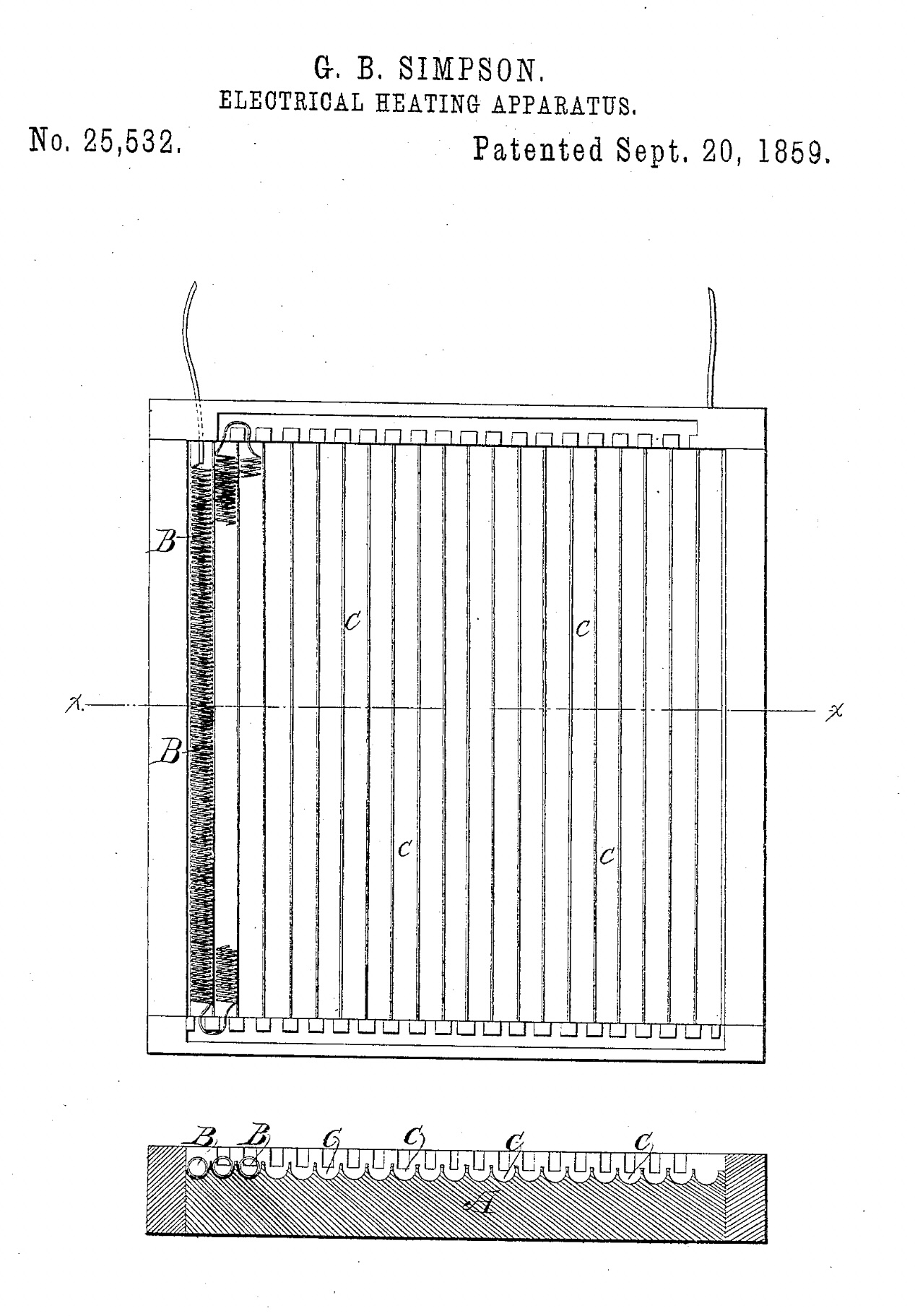
On September 20, 1859, inventor George B. Simpson of Washington, D.C., received U.S. Patent No. 25,532 for an “Improved Electrical Heating Apparatus,” which he called an “electro-heater.” His design used a coil of platinum—or “platina,” in the patent’s terminology—wire laid in grooves on an electrically nonconducting base, shown in the patent as common soapstone. Connected to a galvanic battery, the wire produced heat through electrical resistance.
Simpson wrote that his device could generate enough heat to “warm rooms, boil water, cook victuals, &c.” He proposed supporting the heated wire on an insulating base or enclosing it in metal tubes or vessels insulated from the electric current. In principle, it offered a striking alternative to open-flame heating: controllable heat produced electrically rather than by combustion.
In 1859, however, the technology’s practical limitation was its power source. Most homes had no electrical service—large-scale public electricity systems had not yet become part of domestic life—and Simpson’s apparatus relied on galvanic batteries. Batteries could supply current, but they were not an economical or convenient source of power for widespread home heating or cooking.
Even so, Simpson’s patent is an important early example of electric resistance heating applied to domestic purposes. It anticipated the basic operating principle behind later electric hotplates, ranges, space heaters, and many other household appliances. Hagley Museum and Library describes it as the world’s first patented electric range, though it is best understood as an early battery-powered heating apparatus rather than a fully developed modern stove.
Image: U.S. Patent No. 25,532, George B. Simpson, 1859. Public domain.
