
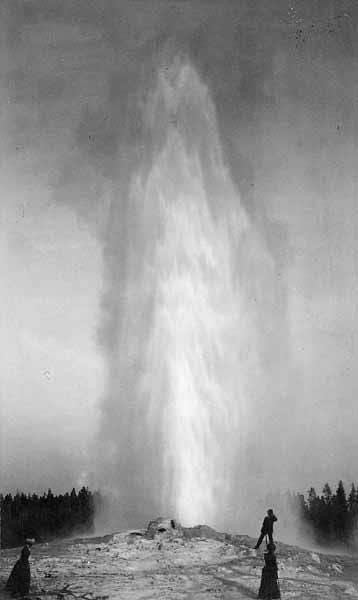
On September 18, 1870, members of the Washburn–Langford–Doane Expedition entered Yellowstone’s Upper Geyser Basin in what was then the Wyoming Territory. There they encountered a powerful geyser whose unusually regular eruptions distinguished it from the basin’s many other thermal features. The party named it Old Faithful, a name generally credited to Henry D. Washburn and recorded by expedition member Nathaniel P. Langford.
The expedition’s observations, journals, maps, and reports helped persuade Americans and Congress that Yellowstone’s extraordinary landscapes deserved protection from private exploitation. Together with the work of later surveys, especially Ferdinand V. Hayden’s 1871 expedition, those accounts contributed to the establishment of Yellowstone National Park in 1872—the world’s first national park. Old Faithful has since become an enduring symbol of American conservation and natural heritage.
Image: “Three people standing in front of Old Faithful Geyser at Yellowstone National Park, circa 1879” by Frank Jay Haynes via Wikimedia Commons, public domain
