
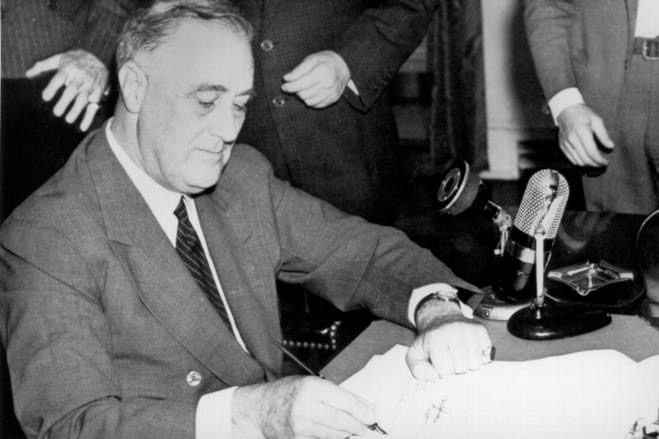
On September 16, 1940, President Franklin D. Roosevelt signed the Selective Training and Service Act into law, creating the first peacetime military draft in United States history. Commonly known as the Burke-Wadsworth Act, the measure passed Congress as the war in Europe intensified and American leaders grew increasingly concerned about the nation’s military preparedness.
The law required men between the ages of 21 and 35 to register for possible military service. It created a nationwide Selective Service System to identify, classify, and induct men for training, greatly expanding the Army at a time when the United States had not yet entered World War II. The first registration took place on October 16, 1940, and millions of men enrolled.
The act marked a major shift in American civic and military life. It gave the federal government a peacetime framework for mobilizing citizens for national defense and helped lay the foundation for the far larger wartime mobilization that followed the Japanese attack on Pearl Harbor in December 1941. In that sense, Roosevelt’s signing of the law was an important turning point: it signaled that the United States was preparing for the possibility that the global conflict would eventually demand its full participation.
Image via Wikimedia Commons, public domain.
