
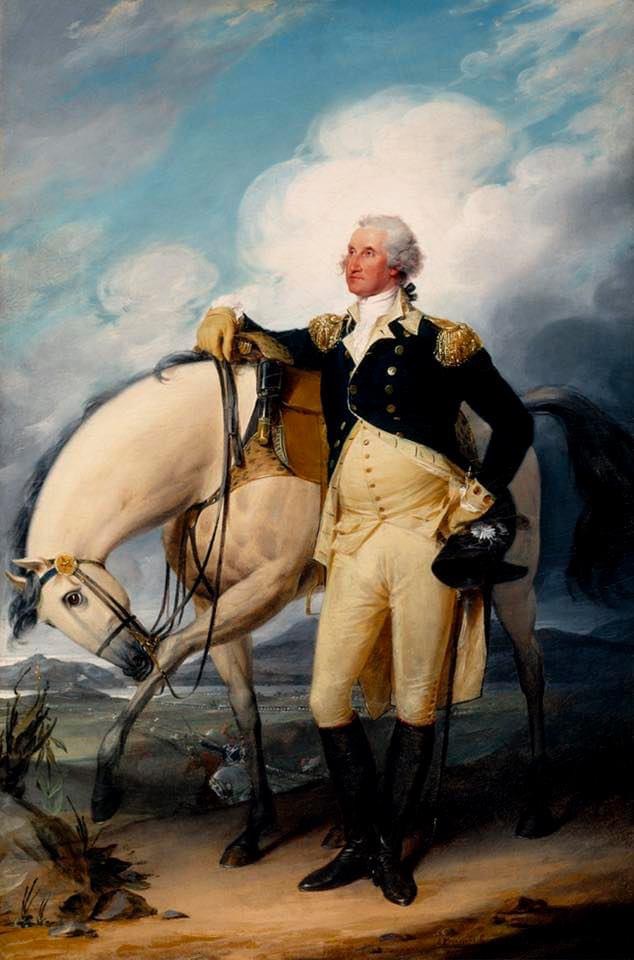
On September 14, 1782, General George Washington staged a grand military review at Verplanck’s Point on New York’s Hudson River. The ceremony honored the departing French commander, the Comte de Rochambeau, and the French army whose alliance with the United States had been indispensable to the victory at Yorktown the previous year.
The review was both a farewell and a display of strength. In John Trumbull’s portrait, Continental troops appear in formation behind Washington, evoking the discipline and endurance of an army that had fought through years of campaigning and hardship. The scene also reflects the importance of the Franco-American alliance at a moment when the war’s military phase was giving way to uncertain negotiations for peace.
Trumbull knew the setting firsthand. A former aide-de-camp to Washington, he had witnessed the Verplanck’s Point encampment and made sketches there in 1782. In 1790, he painted Washington at Verplanck’s Point and presented it to Martha Washington as a gift, describing it as an expression of his “profound and affectionate respect.” The Washingtons displayed the painting at Mount Vernon.
More than a portrait of a victorious commander, the work captures a transitional moment in the Revolution. The disciplined troops and French alliance projected an American army that had become a credible national force—one prepared to convert battlefield success into an enduring peace.
Image: John Trumbull, Washington at Verplanck’s Point (1790), oil on canvas. Original in the collection of the Winterthur Museum, Garden & Library; public-domain reproductions may be available through digital collections.
