
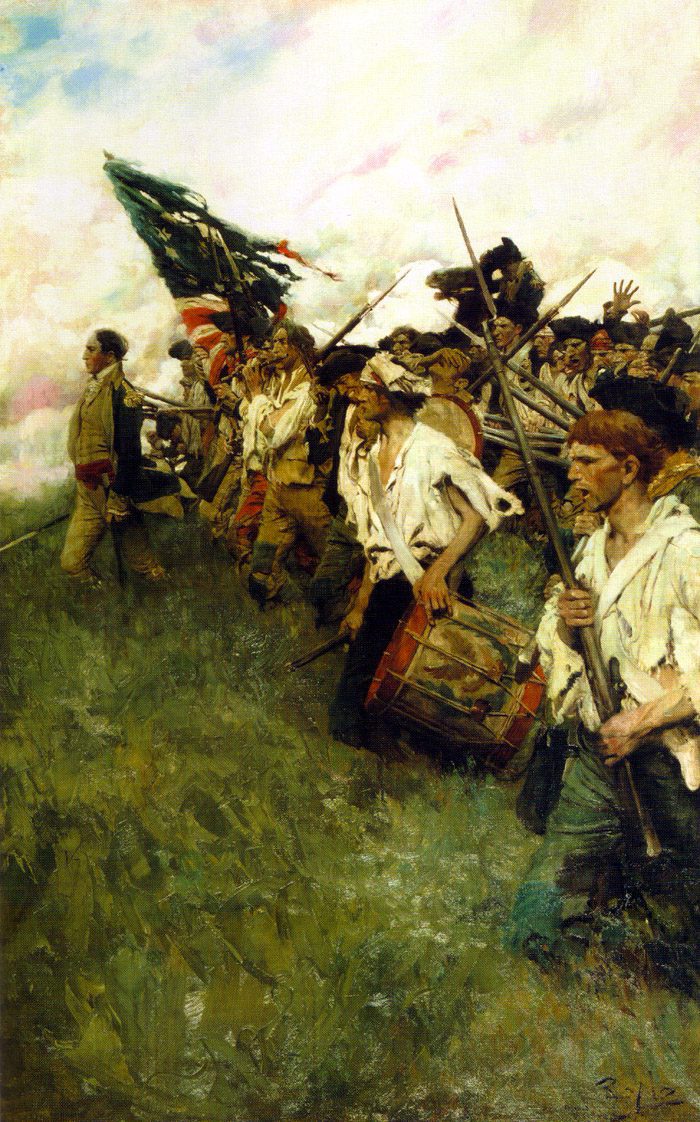
On September 11, 1777, during the American Revolutionary War, the Continental Army under General George Washington fought a British army commanded by General Sir William Howe at the Battle of Brandywine, in present-day Delaware County, Pennsylvania. Washington positioned his troops along the eastern bank of Brandywine Creek in an effort to block the British advance on Philadelphia, then the revolutionary capital.
The battle turned on a complex British flanking maneuver. General Wilhelm von Knyphausen led a force that demonstrated against the American position at Chadds Ford, drawing Washington’s attention to the front. Meanwhile, Howe and Lord Charles Cornwallis led the main British column northward, crossed unguarded upstream fords, and then turned south toward the exposed American right. When the British force appeared near Birmingham Friends Meeting House, Washington rushed troops to establish a defensive line, but the Americans had been strategically outmaneuvered.
Continental troops resisted fiercely, and commanders including Major General Nathanael Greene, the Marquis de Lafayette, John Sullivan, Lord Stirling, and Adam Stephen helped delay the British advance. Their defense gave much of Washington’s army time to withdraw toward Chester rather than face encirclement or destruction.
The defeat had immediate strategic consequences. It opened the way for British forces to occupy Philadelphia on September 26. Yet Brandywine was not a fatal blow to the American cause: Washington retained the core of the Continental Army, enabling the revolutionaries to continue the campaign despite the loss of the capital. The battle therefore revealed serious weaknesses in American reconnaissance and command coordination while also demonstrating the army’s resilience after a major defeat.
Image: “Nation Makers,” by Howard Pyle, via Wikimedia Commons, public domain.
