
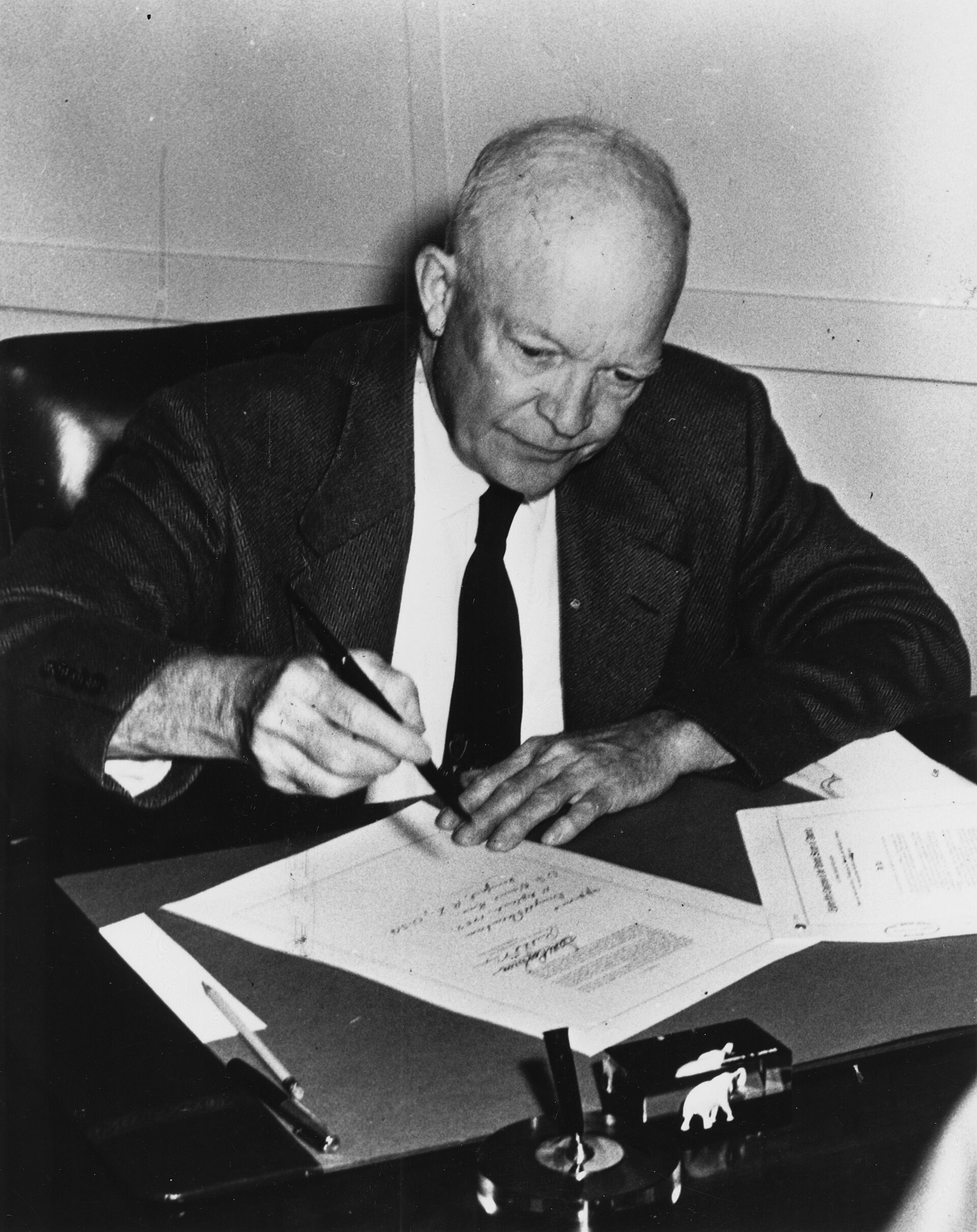
On September 9, 1957, President Dwight D. Eisenhower signed the Civil Rights Act of 1957 into law from his temporary office at the naval base in Newport, Rhode Island. The measure was the first federal civil-rights legislation enacted since the Civil Rights Act of 1875, ending an eight-decade gap in major federal action on civil rights.
The law focused primarily on protecting Black Americans’ voting rights amid systematic disenfranchisement in the Jim Crow South. It authorized federal prosecutors to seek court injunctions against interference with citizens’ voting rights, created the position of Assistant Attorney General for Civil Rights, and established the bipartisan U.S. Commission on Civil Rights to investigate and report on alleged denials of civil and voting rights. The Justice Department subsequently organized its Civil Rights Division to carry out this work.
Southern opponents substantially weakened the bill before its passage, limiting its enforcement power. Senator Strom Thurmond of South Carolina nevertheless staged a one-man filibuster lasting more than 24 hours—the longest individual Senate speech on record at the time—in a failed attempt to stop the legislation.
Although the act proved too weak to end widespread voter suppression on its own, it marked an important shift in federal civil-rights policy. By creating permanent federal institutions devoted to investigating discrimination and enforcing constitutional rights, it helped lay institutional and legal groundwork for the stronger civil-rights measures of the 1960s, especially the Voting Rights Act of 1965.
Image: President Dwight D. Eisenhower signs the Civil Rights Act of 1957 in Newport, Rhode Island, September 9, 1957. Wikimedia Commons / U.S. Navy, public domain.
