
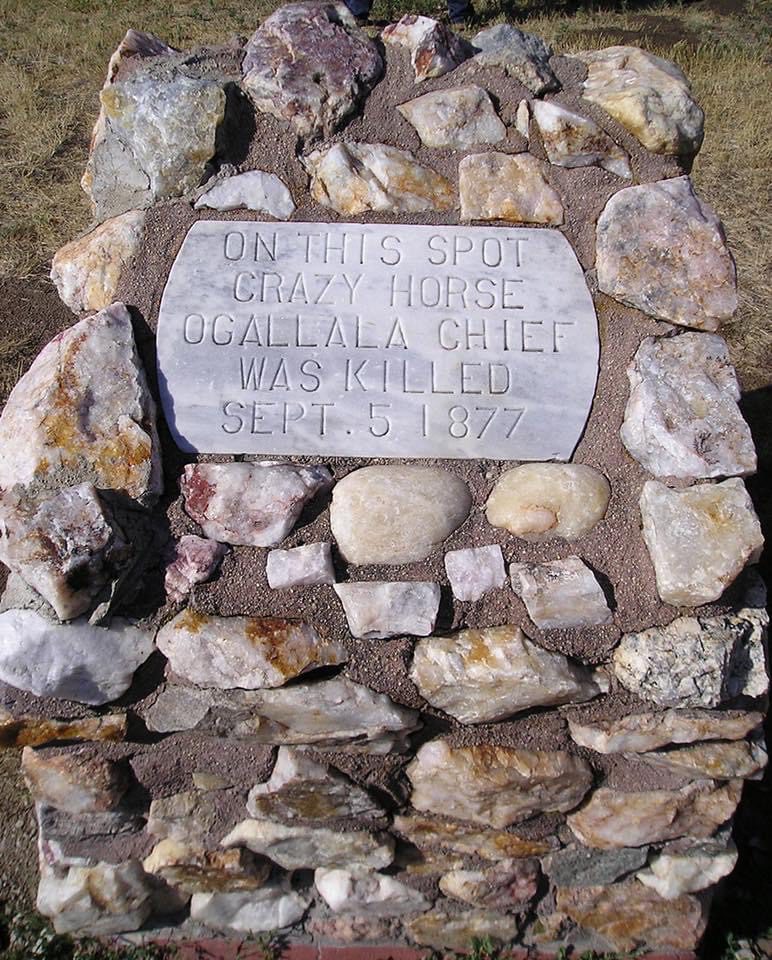
On September 5, 1934, Fort Robinson near Crawford, Nebraska, dedicated paired stone monuments honoring Oglala Lakota war leader Crazy Horse and First Lt. Levi H. Robinson, for whom the fort was named. The monument to Crazy Horse marked the site near where he was mortally wounded on September 5, 1877, while resisting imprisonment after his surrender earlier that year.
A central figure in Lakota resistance during the Great Sioux War of 1876–77, Crazy Horse became an enduring symbol of Native sovereignty, resistance, and survival. His memorial’s placement within a former military outpost makes the site especially resonant: it joins the history of U.S. military expansion with the memory of the Indigenous people who resisted dispossession.
The 1934 ceremony came during an era when public institutions increasingly sought to preserve and commemorate sites associated with the Indian Wars. Yet the pairing of memorials was meaningful and complicated. It placed a Lakota leader killed at the fort alongside the Army officer whose name the fort bears, publicly acknowledging two lives shaped by the violent conflict over the northern Plains. Contemporary accounts described it as an unusually significant official memorialization of a Native American warrior in the West.
Today, Fort Robinson remains a solemn destination for visitors exploring the history of the northern Plains. The Crazy Horse monument is not simply a marker of death; it reflects the continuing struggle over how the United States remembers westward expansion, military power, Indigenous land, and Native resistance.
Image via Wikimedia Commons, CC BY-SA 3.0
