
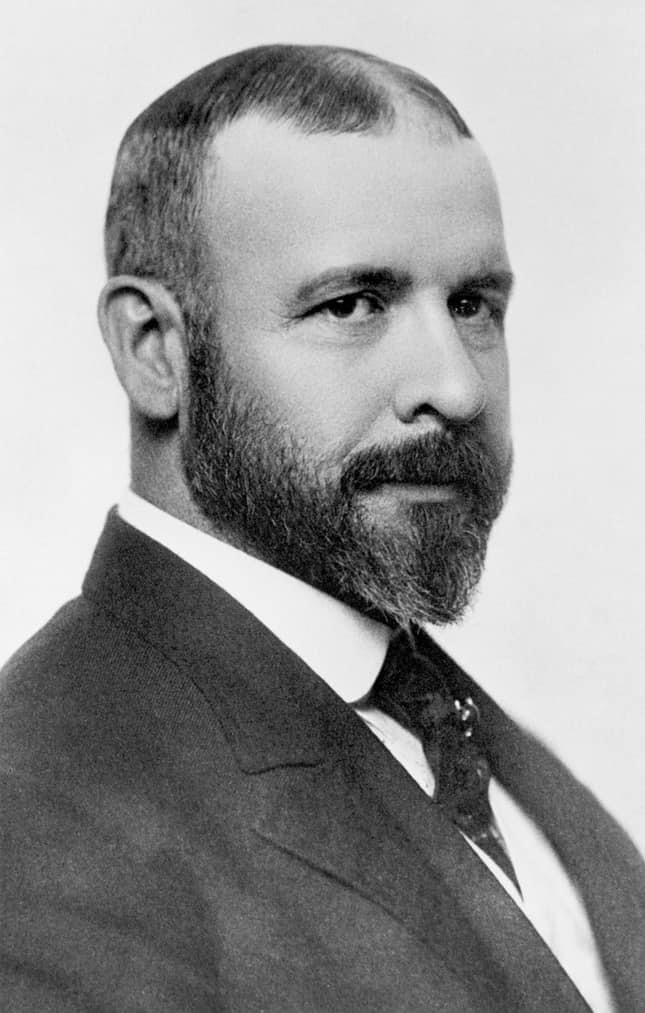
On September 3, 1856, Louis Sullivan was born in Boston, Massachusetts. Over the course of his career, the American architect would become one of the defining figures of the Chicago School and a major influence on modern American architecture. Often called a “father of the skyscraper” and the spiritual father of modern American architecture, Sullivan helped establish a new visual language for the tall commercial building.
With his partner, Dankmar Adler, Sullivan designed some of the late 19th century’s most influential buildings, including Chicago’s Auditorium Building, the Wainwright Building in St. Louis, and Buffalo’s Guaranty Building. Their partnership produced more than 100 works between 1879 and 1895, combining Adler’s technical and organizational strengths with Sullivan’s powerful sense of form, space, and ornament.
Sullivan is best known for the principle often shortened to “form follows function”—his original phrase was “form ever follows function.” He believed that a building’s design should grow from its purpose rather than imitate older architectural styles. Yet Sullivan was not an enemy of decoration: his façades, especially the Guaranty Building’s richly patterned terra cotta, show how ornament could be original, organic, and integral to a modern building rather than borrowed from Greek or Roman precedents.
His tall office buildings helped articulate the possibilities of steel-frame construction, large windows, and vertical design. Rather than merely making buildings taller, Sullivan sought to make them look tall—to give the modern office tower an architectural identity equal to its new structural technology.
Sullivan’s later life was difficult. After his partnership with Adler ended and architectural fashion moved toward historical classicism, his major commissions declined. He died poor and largely isolated in a Chicago hotel room on April 14, 1924. Frank Lloyd Wright, who had worked in Sullivan’s office and called him “Lieber Meister,” helped cover the costs of Sullivan’s funeral and burial.
Image: Louis Sullivan, c. 1895, via Wikimedia Commons, public domain
