
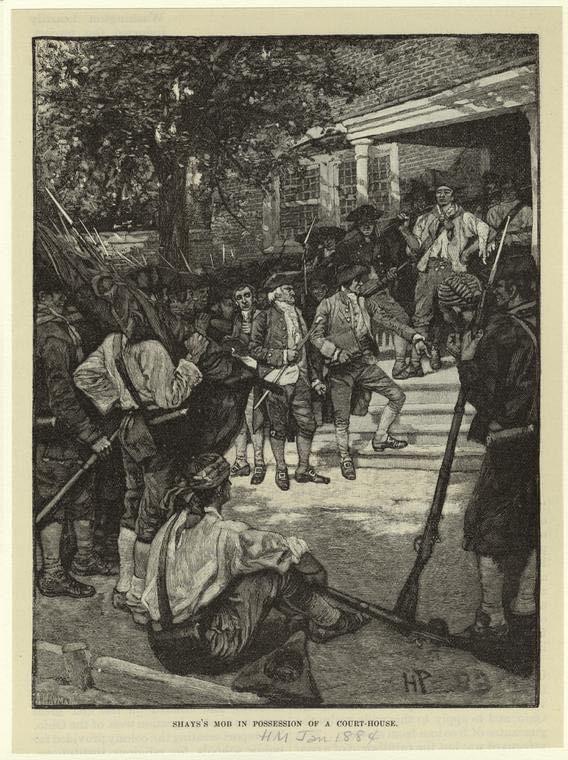
In late August 1786, rural protest in western Massachusetts escalated when armed groups prevented the county court in Northampton from sitting, an action commonly treated as the opening of Shays’ Rebellion. Farmers burdened by high state taxes, private debts, scarce hard currency, and debt-collection suits sought to stop courts from issuing judgments that could lead to imprisonment, property seizure, or foreclosure. Revolutionary War veteran Daniel Shays emerged as one of the rebellion’s most prominent leaders, though the movement included multiple local organizers and was not initially centralized.
The uprising exposed practical weaknesses in the Articles of Confederation: Congress lacked an independent authority to raise troops and had to rely on state cooperation, while Massachusetts ultimately relied on a state-organized militia to suppress the insurgency. Shays’ Rebellion did not alone cause the Constitutional Convention—reform efforts and dissatisfaction with the Articles predated it—but it heightened elite fears about political disorder and strengthened the case, made by figures including Washington, Hamilton, and Madison, for a more effective national government. The Philadelphia Convention was called in February 1787, while the rebellion was still unfolding.
