
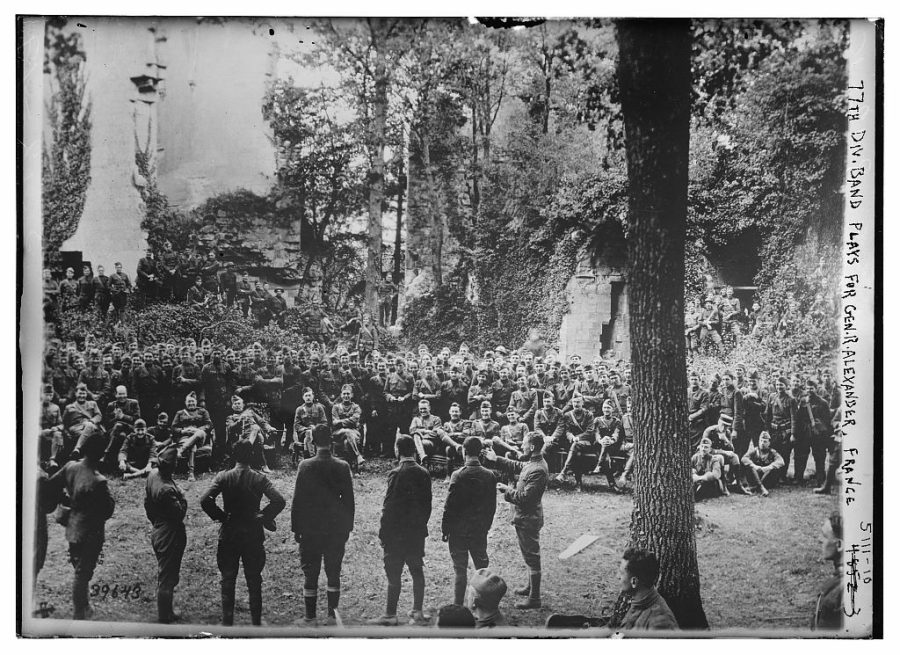
On August 27, 1918, during the high-stakes final offenses of World War I, the concert band and orchestra of the U.S. Army’s 77th Infantry Division performed a specialized symphonic concert inside the shattered stone ruins of Château de Fère in northern France. The classical orchestration was executed directly behind the frontlines to provide a necessary operational pause for Major General Robert Alexander and his exhausted personnel.
The musical performance staged on August 27th was a magnificent demonstration of military morale management executed under the constant threat of enemy artillery fire. The medieval fortress, whose construction originally began in the year 1206, had been heavily bombarded and cleared of German occupying forces just days prior during the bloody Aisne-Marne counteroffensive. By deliberately positioning a full military orchestra within the broken gothic arches and exposed masonry of the historic castle, command staff visually projected an air of cultural resilience and tactical stability to the combat units preparing for the next push.
The shattered backdrop records a striking contrast, matching formal uniform discipline against ancient, war-torn architecture to illustrate the complex psychological realities of the Western Front. The brief concert successfully provided frontline soldiers with an essential mental respite, demonstrating how classical melodies could offer comfort amidst widespread devastation. The archival print remains an insightful record of early twentieth-century military culture, documenting a moment where creative expression was utilized as a functional tool to reinforce human stamina during a brutal campaign of attrition.
Image via LOC, no known restrictions
