
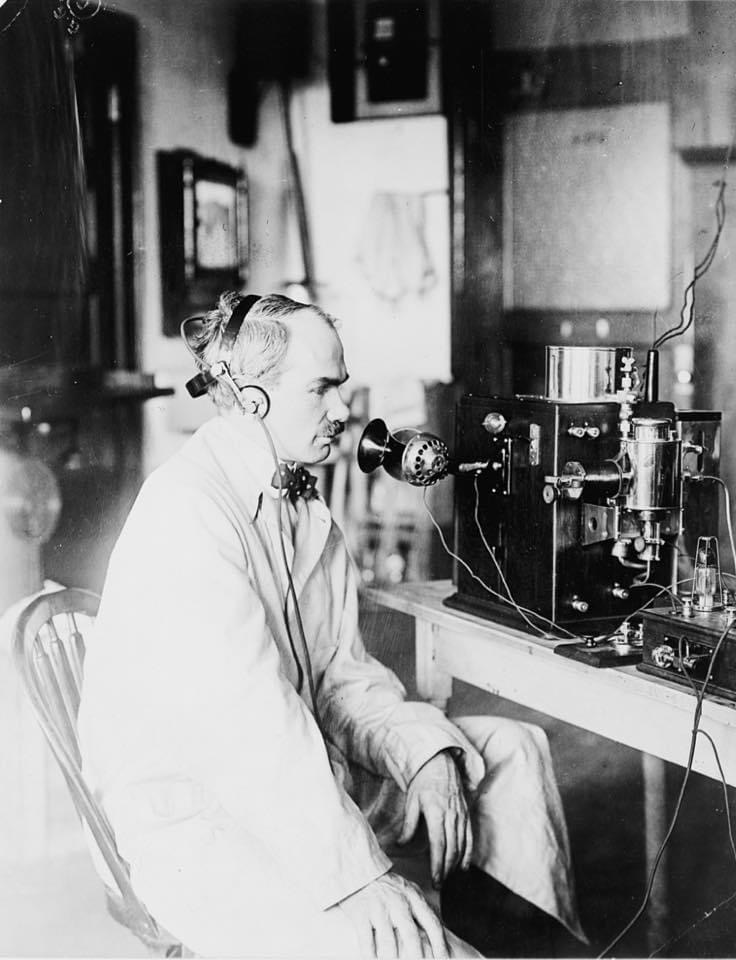
Pioneering inventor and electronics engineer Lee de Forest was born on August 26, 1873, in Council Bluffs, Iowa. Developing an early mastery of mechanical physics and electrical currents, his extensive laboratory research yielded over three hundred patents, establishing the technological infrastructure for modern radio broadcasting and television networks.
De Forest’s birth introduced a relentless creative force who fundamentally transformed the sensory experience of mass media entertainment. In 1919, he engineered a breakthrough process known as the “Phonofilm,” which recorded sound waves directly onto standard film material as optical linear traces that could be amplified in synchronization with the moving images. Prior to this innovation, cinema was structurally silent, relying on live theater pianists to guide the emotional contours of an audience, but de Forest’s sound-on-film method allowed for the precise, mechanical reproduction of dialogue and orchestration.
While his early audio systems faced intense skepticism from major Hollywood studio executives who resisted the high costs of industrial conversion, his technical layouts laid down the exact stepping stones that eventually launched the talking-picture revolution. His long career remains an insightful record of industrial persistence and consumer marketing, demonstrating how a single electrical technician could rewrite the global playbook for creative storytelling and human communication.
Image: Lee de Forest seated with one of his inventions via Wikimedia Commons, public domain.
