
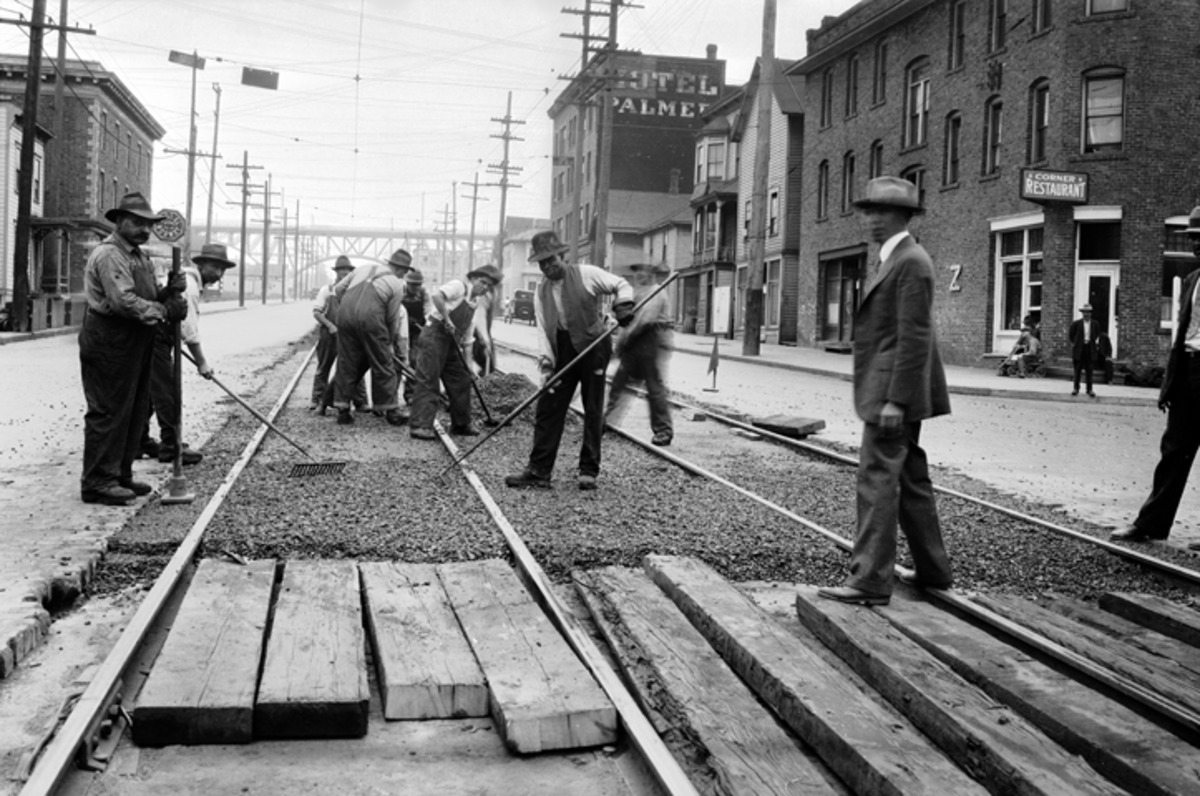
A documentary photograph taken on August 24, 1927, captures the intensive industrial street work underway at 7th Avenue and Dearborn Street in Seattle, Washington. The scene reflects the broader Denny Regrade — the audacious engineering campaign that sought to remake the city’s geography by removing the steep glacial hills that constrained its growth.
Seattle’s early topography created severe logistical barriers: rail lines, streetcars, and freight corridors could not expand across abrupt slopes. In response, municipal planners deployed steam shovels, heavy tractors, and hydraulic “giant” hoses capable of washing entire hillsides into Elliott Bay. The project converted vertical, inaccessible terrain into uniform, developable land, fundamentally reshaping the city’s commercial core.
The high‑contrast archival image shows a landscape mid‑transformation, with steam machinery cutting into sheer walls of exposed earth — a stark testament to the mechanical confidence of the machine age. By flattening its own topography, Seattle accelerated commercial circulation, opened space for modern high‑rises, and expanded its shipping and industrial terminals. This snapshot captures the precise moment engineering ambition redefined a frontier city.
Image from Seattle Municipal Archives via Wikimedia Commons, CC BY 2.0.