
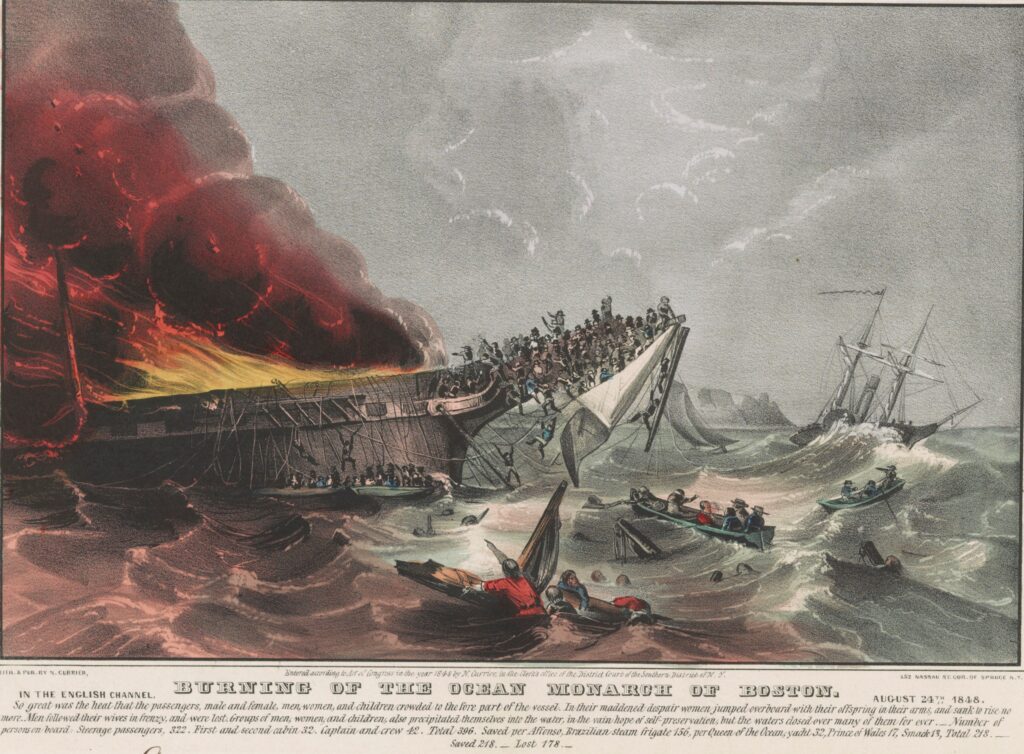
On August 24, 1848, the American barque Ocean Monarch caught fire off the coast of Wales shortly after departing Liverpool for Boston. Within minutes, the wooden passenger ship was engulfed in flames visible from shore, and despite rapid rescue attempts by nearby vessels — including the Prince of Wales and the Brazilian — nearly 180 passengers and crew were lost. The ship burned so fiercely and so quickly that many aboard had no chance to escape the choking smoke and collapsing decks.
Investigators later determined that the blaze began when passengers smoked pipes in the lower hold, violating strict orders from the ship’s officers. The embers ignited dry bedding and cargo materials, producing a sudden, explosive spread of fire through the cramped wooden interior. Families were trapped between a burning deck and frigid waters, and the speed of the conflagration exposed the lethal vulnerabilities of mid‑nineteenth‑century transatlantic travel, where a single careless spark could overwhelm even well‑built vessels.
The catastrophe sent shockwaves through New England shipping communities and forced maritime companies to impose far stricter rules regarding open flames aboard passenger ships. The Ocean Monarch tragedy became a brutal lesson in how human negligence could override engineering and seamanship, cutting short a routine voyage in a matter of minutes. Its legacy helped drive reforms in passenger safety regulations, underscoring the heavy human cost of ignoring fire hazards on the open ocean.
Image via Wikimedia Commons, no known restrictions.
