
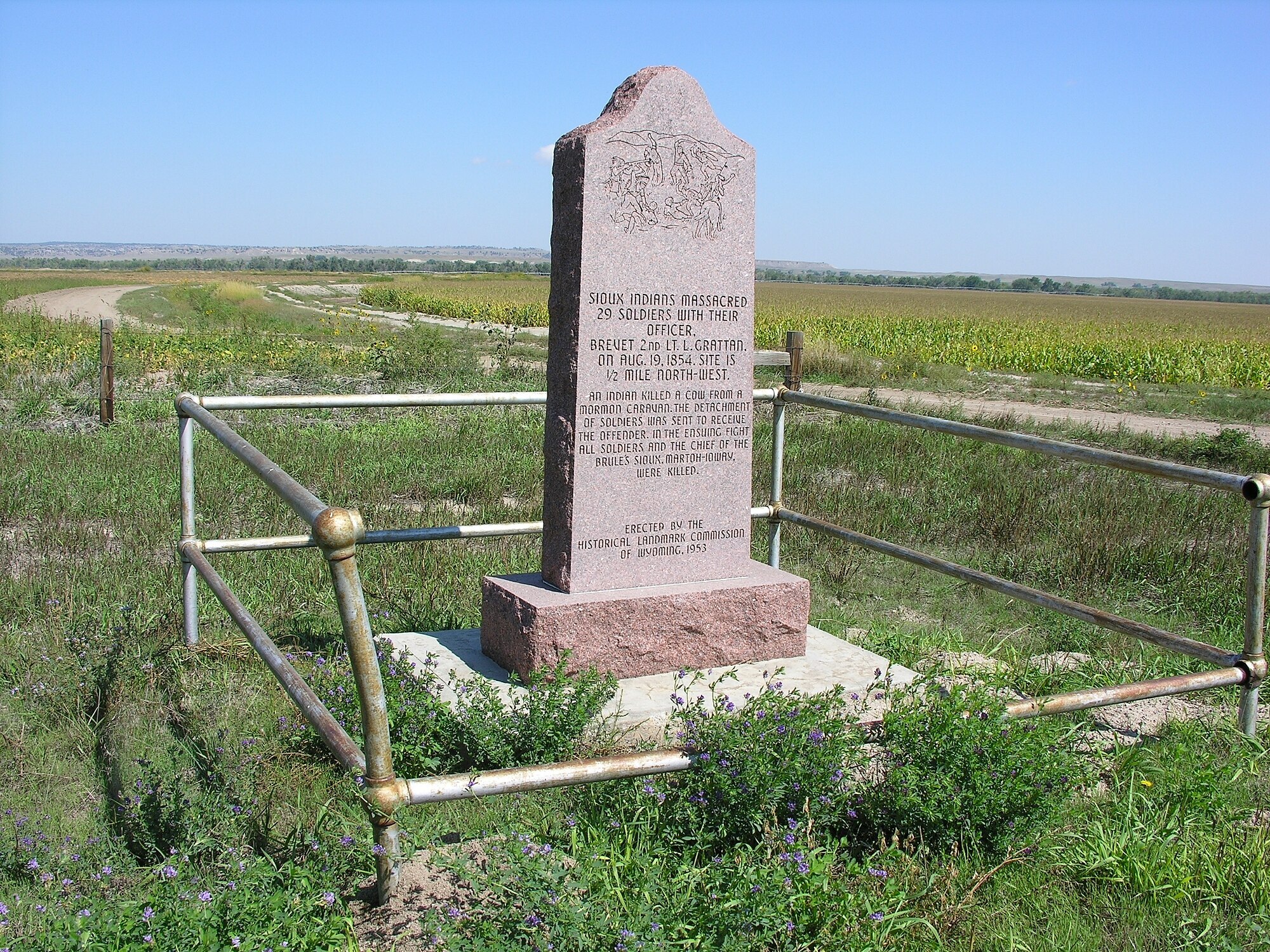
With the disastrous encounter next to Fort Laramie – later characterized as the “Grattan Massacre” – the First Sioux War started on August 19, 1854. Lieutenant John Grattan led a detachment of US soldiers to arrest a Lakota man, who had allegedly killed a settler’s cow, not only breaking treaty stipulations, but furthermore completely ignoring the diplomatic processes that should have existed to prove this man’s innocence. During the conflict Chief Conquering Bear was shot, and Lakota warriors sought revenge killing Grattan and his men. The incident was a product of arrogance, misunderstandings and violations of previous agreements, igniting a state of war that would shape the next several decades of the US-Lakota relationship.
The high-stakes friction that exploded near the Oregon Trail on August 19th exposed the dangerous, systemic failure of federal frontier bureaucracy when managing tribal sovereignty. Grattan, a twenty-four-year-old West Point graduate brimming with aggressive, anti-Native prejudice, marched into a peaceful encampment of thousands of Brule Lakota accompanied by twenty-nine heavily armed regulars and two artillery pieces. He fiercely demanded the immediate surrender of the migrant hunter, contemptuously brushing aside the efforts of Chief Conquering Bear, who sought to defuse the situation by offering a valuable horse from his personal herd as a lawful replacement for the stray cow.
When Grattan ordered his nervous troops to fire a sudden, unprovoked volley into the council lodge, the reckless escalation proved immediately fatal. The opening barrage mortally wounded Chief Conquering Bear, instantly destroying any hope of a peaceful resolution and prompting hundreds of hidden Lakota warriors to launch a defensive counterattack. Within minutes, the overwhelming mounted force completely enveloped Grattan’s column, wiping out the entire detachment in a chaotic, close-quarters melee that shattered the fragile peace established by the 1851 Treaty of Fort Laramie.
The tragic loss of life served as a devastating, long-term catalyst that locked the American West into a brutal, multi-decade cycle of military campaigns and broken promises. Federal commanders utilized distorted press reports of the “massacre” to justify a series of aggressive, scorched-earth retaliatory expeditions against the Plains tribes, effectively creating a permanent state of warfare that would culminate at the Little Bighorn and Wounded Knee. The Grattan incident remains a somber monument to the human cost of cultural arrogance, proving that when military force replaces patient diplomacy, a single stray spark can alter the trajectory of a continent.
Image via Wikimedia Commons
