
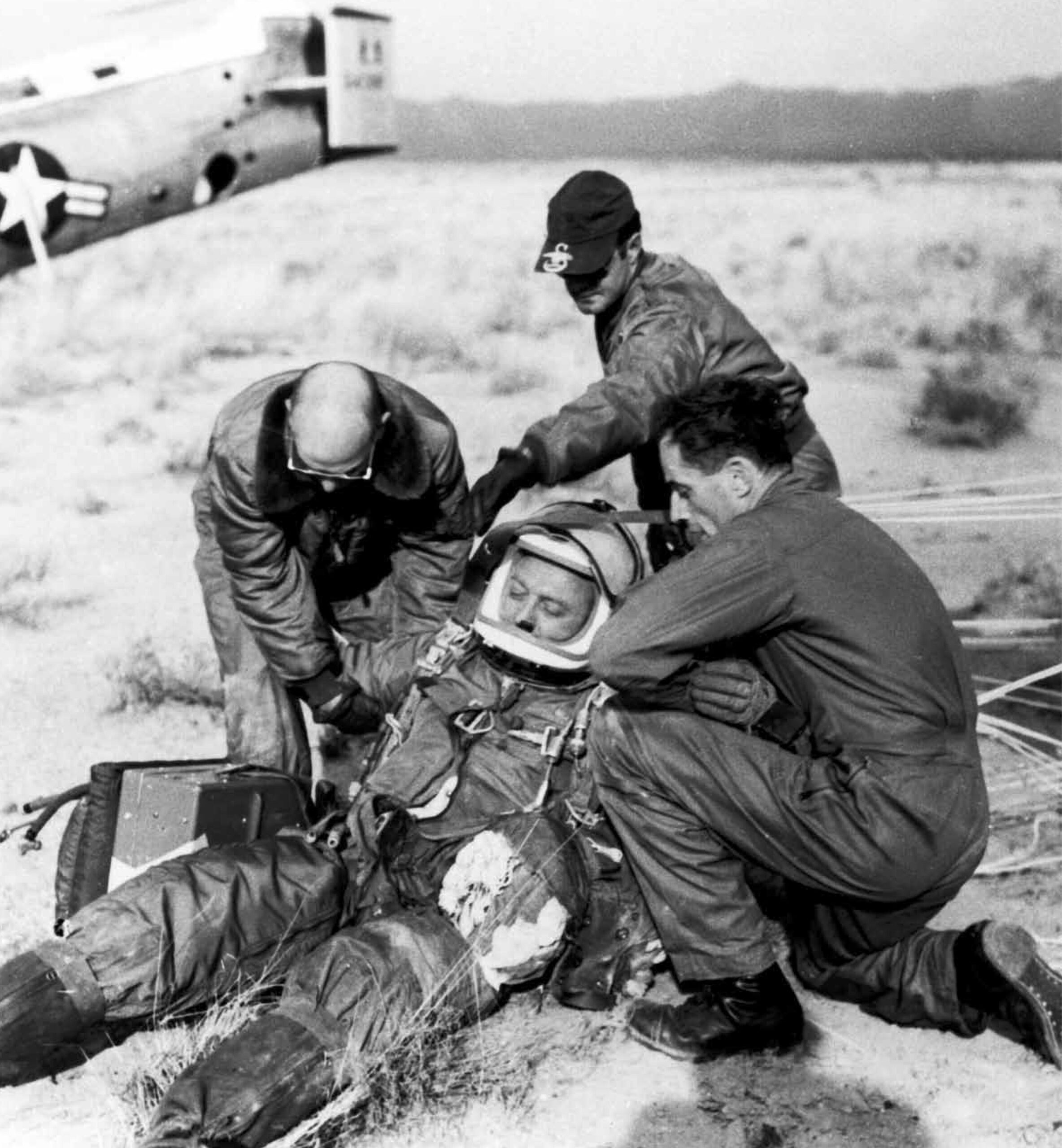
August 16, 1960 — A Man Falls Toward Earth to Save the Men Who Would One Day Leave It.
On this day, U.S. Air Force Captain Joseph Kittinger climbed into an open gondola no larger than a backyard porch swing and rose to the edge of space beneath a balloon so vast it could have swallowed a football stadium. He wasn’t chasing a record. He wasn’t chasing glory. He was chasing answers — the kind that might save a pilot who ejects at 100,000 feet, or an astronaut whose capsule fails on the long road home.
At 102,800 feet, the sky above him was black as ink and the Earth below curved like a living map. During the ascent, the pressure seal in his right glove failed, and his hand swelled painfully to twice its size. He told no one. He knew that aborting the mission would erase months of research and leave future airmen vulnerable. So he endured the pain, saluted the horizon, and stepped off into the void.
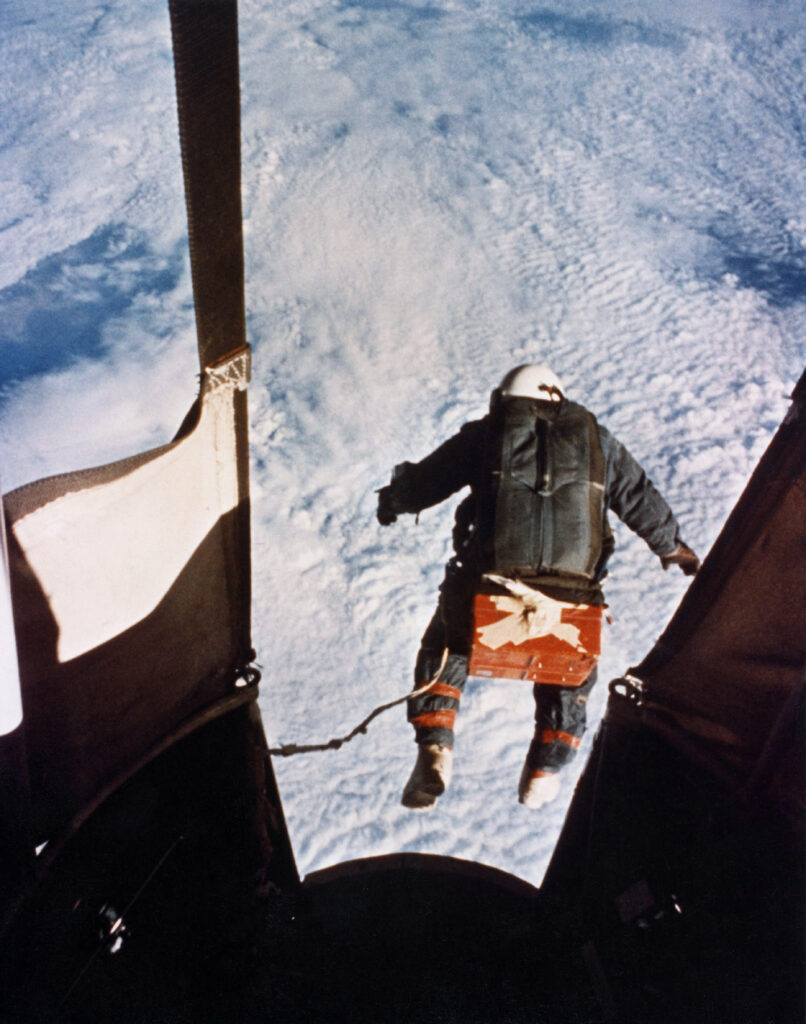
For 4 minutes and 36 seconds, Kittinger fell alone through the stratosphere — a tiny human silhouette drifting between the stars and the desert floor. He accelerated to 614 miles per hour, nearly breaking the sound barrier with nothing but a drogue chute to keep him from spinning to death. He didn’t feel the speed; the air was too thin to touch him. Only when the atmosphere thickened did the wind finally roar to life around his body.
He opened his parachute at 18,000 feet and landed safely in the New Mexico desert, completing the longest freefall ever attempted. His data shaped the survival protocols for every high-altitude aviator and every astronaut who followed. And decades later, when Felix Baumgartner prepared to break his record, it was Kittinger — older now, softer-spoken, still fearless — who guided him from mission control.
Joseph Kittinger didn’t just fall from the edge of space.
He built a bridge between the unknown and the men who dared to cross i
