
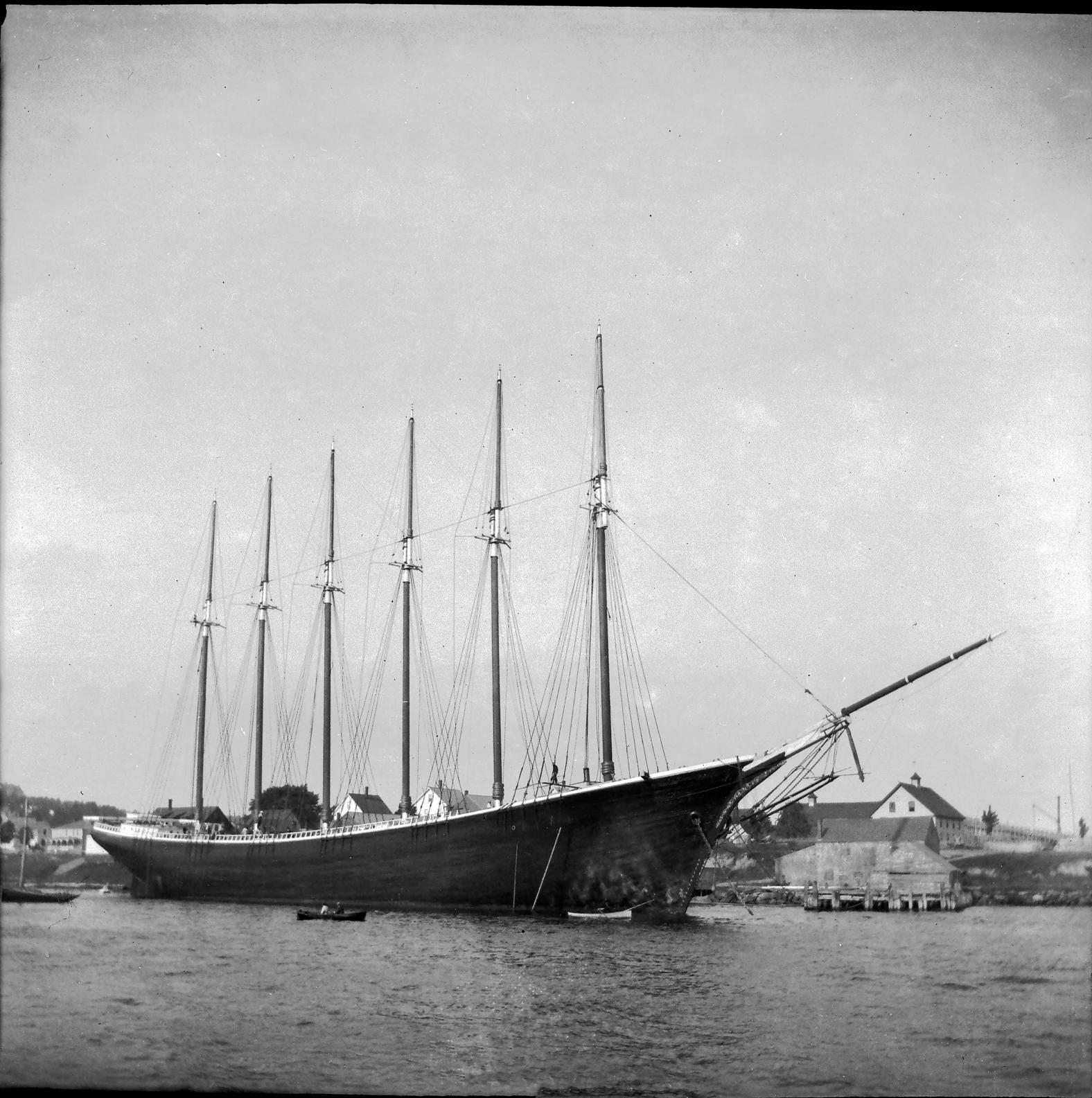
The George W. Wells, launched on August 14, 1900, from Camden, Maine, was the world’s first six-masted schooner—a bold leap in maritime design and scale. Named for George Washington Wells, president of the American Optical Company in Southbridge, Massachusetts, the vessel drew a crowd of over 10,000 spectators to its launch. Measuring 325 feet in length and 48 feet in width, with masts towering over 119 feet, the Wells was the largest wooden schooner afloat in the world at the time. Built for the coastal cargo trade—hauling coal, lumber, and other bulk goods—it quickly became one of the most admired ships of its era. Though tragically lost in a storm off the coast of North Carolina in September 1913, its legacy endures as a symbol of American ingenuity, ambition, and the fleeting grandeur of the age of sail.
The engineering required to operate a wooden hull of such unprecedented length pushed nineteenth-century shipwright technology to its absolute limit. Because massive wooden vessels were prone to “hogging”—bending and sagging over ocean swells due to the flexibility of timber—the Wells had to be reinforced internally with an intricate system of heavy iron diagonal bracing belts hidden behind her oak planking. Her radical six-masted configuration allowed her to carry an astonishing 11,000 square yards of canvas sail while requiring a surprisingly small crew of only fourteen sailors, relying heavily on steam-powered donkeys on deck to raise the massive anchors and heavy wooden booms. This blend of traditional sail craft and industrial steam power made her a high-efficiency marvel, proving that timber could briefly hold its own against the rapidly rising global empire of steel and iron steamships.
Image via Alamy
