
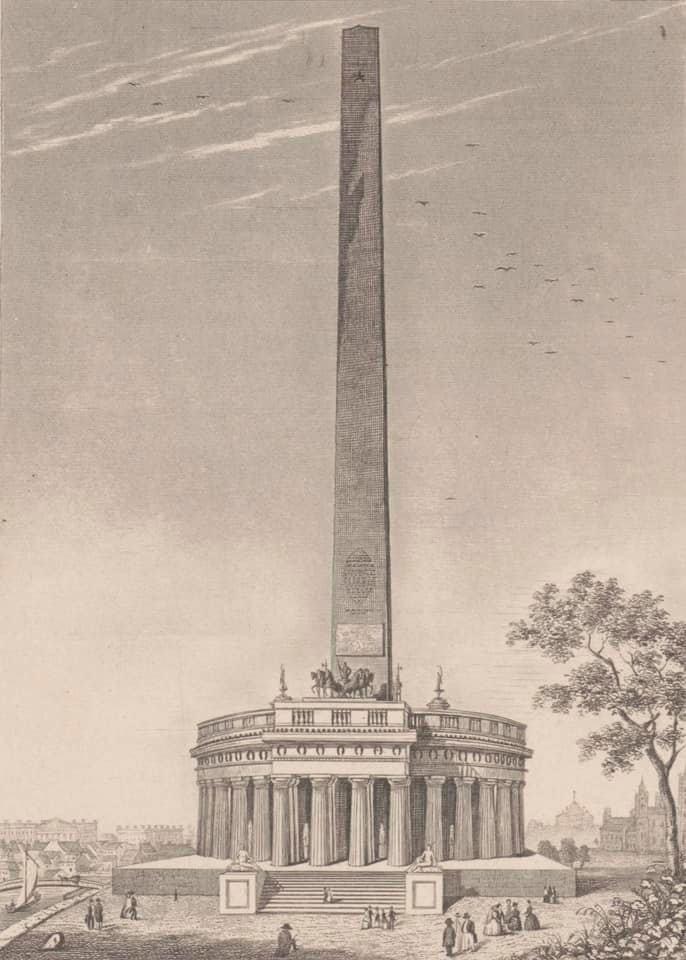
August 12, 1781, marked the birth of Robert Mills in Charleston, South Carolina, a visionary architect destined to leave a permanent, towering mark on the physical skyline of the American republic. As the very first native-born American to receive professional, formal training in architecture within the United States, Mills dedicated his career to engineering public structures that reflected the grand scale and democratic ideals of the young nation. His supreme, career-defining opportunity arrived when he won the highly competitive national design contest to construct a massive monument dedicated to George Washington in the heart of the nation’s capital.
Mills’s original, incredibly ambitious design was a far cry from the stark, minimalist stone obelisk that stands in Washington, D.C., today. His initial blueprints featured a soaring, 600-foot Egyptian-style obelisk surrounded at its base by a colossal, circular Greek pantheon adorned with statues of Revolutionary War heroes and a massive triumphal chariot carrying Washington himself. However, this grand architectural vision was quickly derailed by severe, compounding financial crises, intense political infighting, and the outbreak of the American Civil War, which halted construction entirely for over two decades.
When construction finally resumed under the direction of the U.S. Army Corps of Engineers, Mills’s ornate, expensive pantheon design was completely abandoned due to structural weight concerns and a radical shift toward clean, neoclassical aesthetics. The massive delay left a literal mark on the monument that is still visible to visitors today: a distinct, undeniable color shift in the marble roughly one-third of the way up the structure, marking the precise spot where construction stopped in 1854 and resumed decades later. Although Mills did not live to see his altered masterpiece completed, his birth on August 12 stands as the genesis of an architectural journey that gave America its most recognizable symbol of national pride.
