
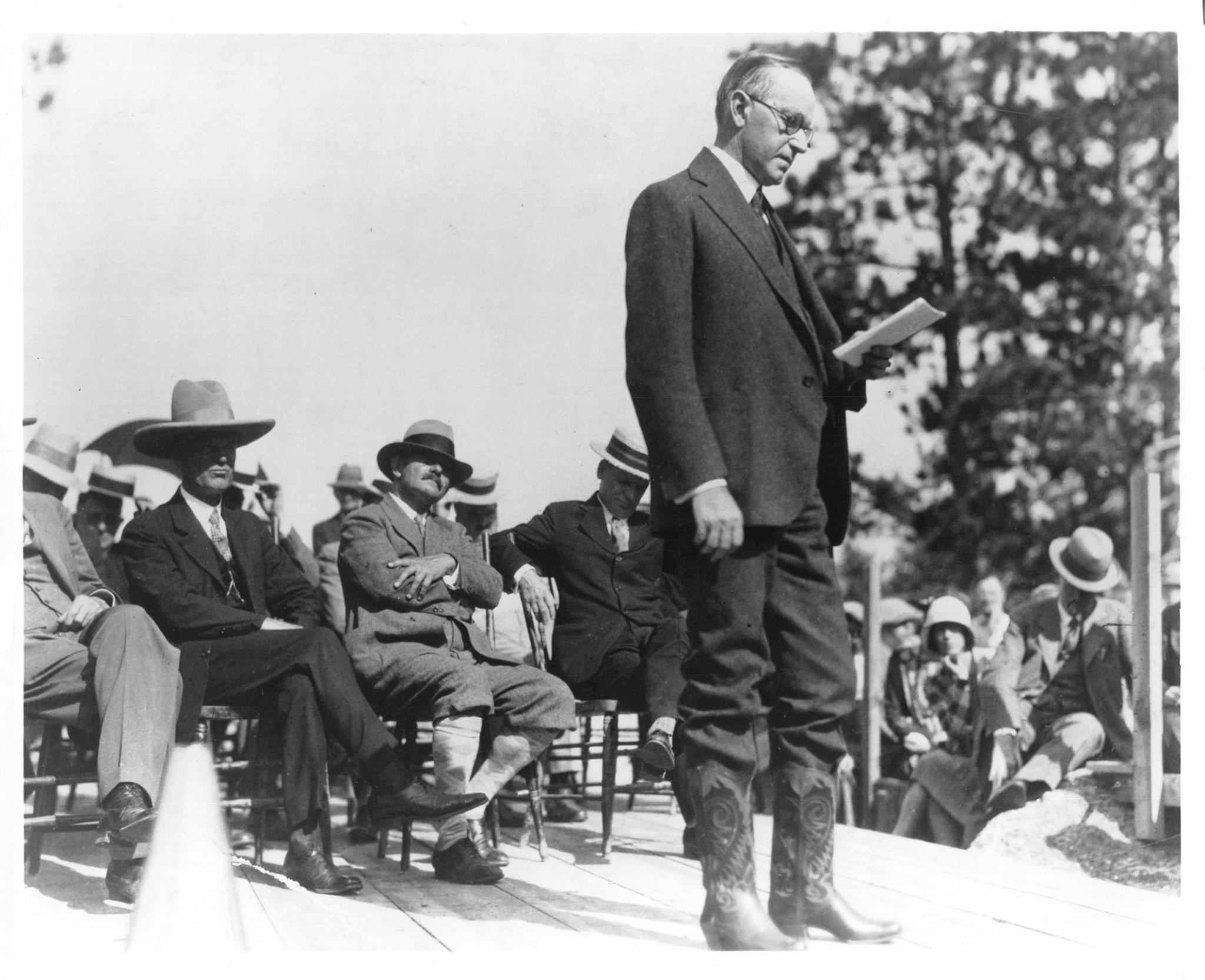
President Calvin Coolidge (wearing fancy cowboy boots) speaking at the Dedication of Mount Rushmore – August 10, 1927.
Coolidge’s formal address on August 10th officially launched the carving of Gutzon Borglum’s massive mountain monument, serving as a fascinating public relations spectacle designed to soften the president’s notoriously cold, taciturn public image. To escape the stifling summer heat of Washington, D.C., Coolidge had established a temporary “Summer White House” in the Black Hills of South Dakota, spending weeks fly-fishing, wearing elaborate Western attire, and accepting gifts from local communities. His presence at the dedication ceremony drew thousands of spectators to the remote granite peak, turning a controversial infrastructure project into a national media sensation.
The political theater surrounding the dedication, however, stood in sharp contrast to the painful, unresolved history of the landscape. The Black Hills were considered deeply sacred ground by the Lakota Sioux, and the carving of American presidents into the stone was viewed by many Indigenous people as a profound violation of the Treaty of Fort Larramie, which had originally guaranteed the land to the tribe forever. By delivering a patriotic speech that framed Mount Rushmore as a timeless symbol of American expansion and democratic permanence, Coolidge used the executive office to cement federal control over the West, leaving behind an artistic and political legacy that remains deeply contested.
Image via Wikimedia Commons, public domain
