
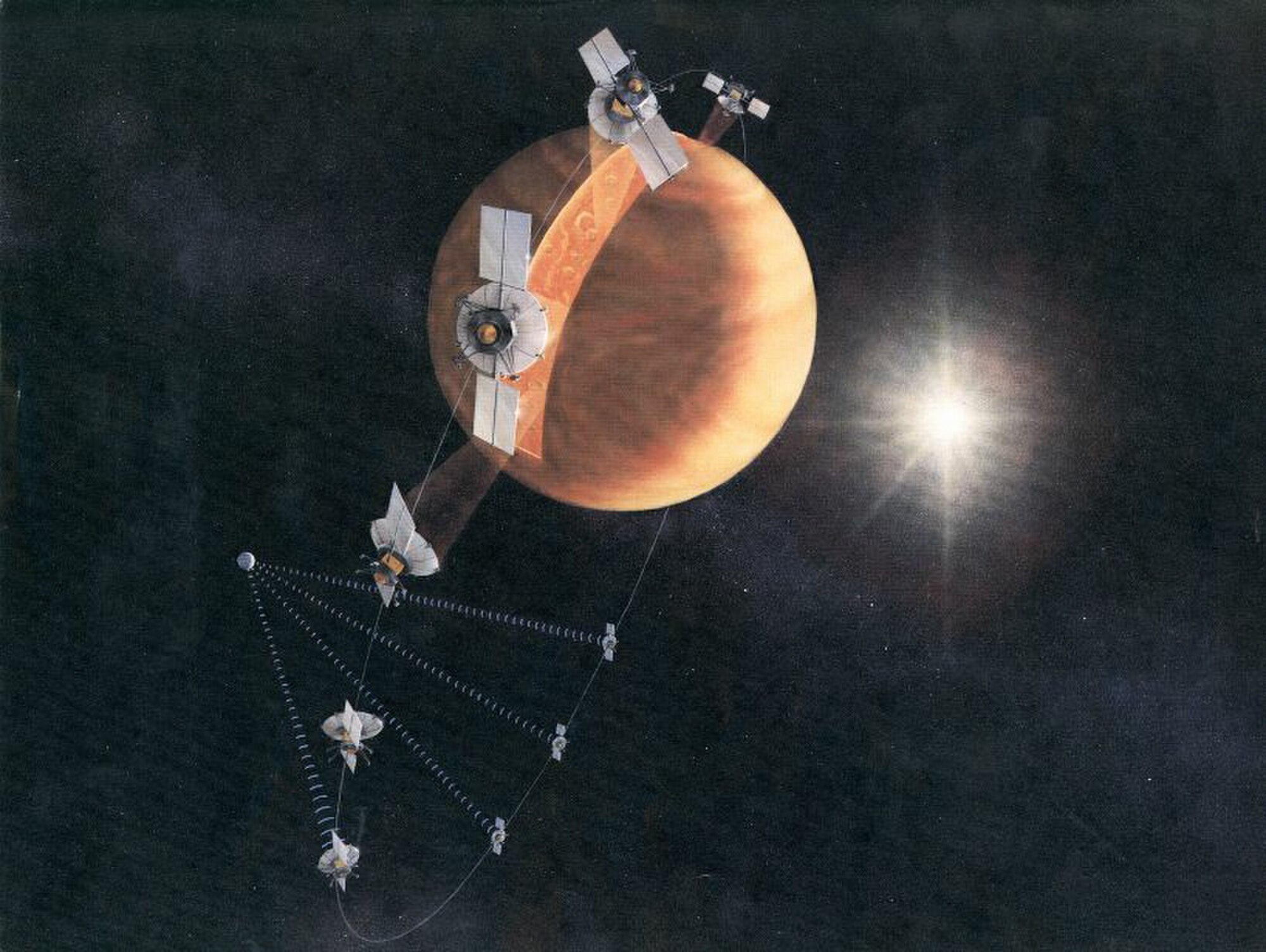
On August 10, 1990, NASA’s Magellan space probe began orbiting the planet Venus. The probe was launched over a year earlier in May of 1989.
Magellan’s arrival in orbit on August 10th revolutionized planetary science by initiating the first comprehensive, high-resolution radar mapping of Venus’s heavily obscured surface. Because the planet is perpetually shrouded in a dense, suffocating atmosphere of carbon dioxide and sulfuric acid clouds, traditional optical cameras could see absolutely nothing but a smooth, featureless yellow haze. Magellan utilized an advanced synthetic aperture radar system to slice through the thick atmospheric blanket, bouncing radio waves off the terrain below to transmit stunning, three-dimensional imagery back to Earth.
The data returned by Magellan exposed a geologically violent and alien world dominated by massive shield volcanoes, vast rivers of hardened lava, and bizarre, web-like fracture patterns known as arachnoids. For over four years, the durable probe mapped more than 98 percent of the planet, proving that Venus was a geologically active sister world to Earth that had experienced a catastrophic greenhouse effect. The mission concluded in 1994 when scientists intentionally commanded Magellan to plunge directly into the crushing Venusian atmosphere, gathering final aerodynamic data before the extreme heat and pressure vaporized the spacecraft.
Image: Artist depiction of Magellan orbiting Venus via Wikimedia Commons, public domain
