
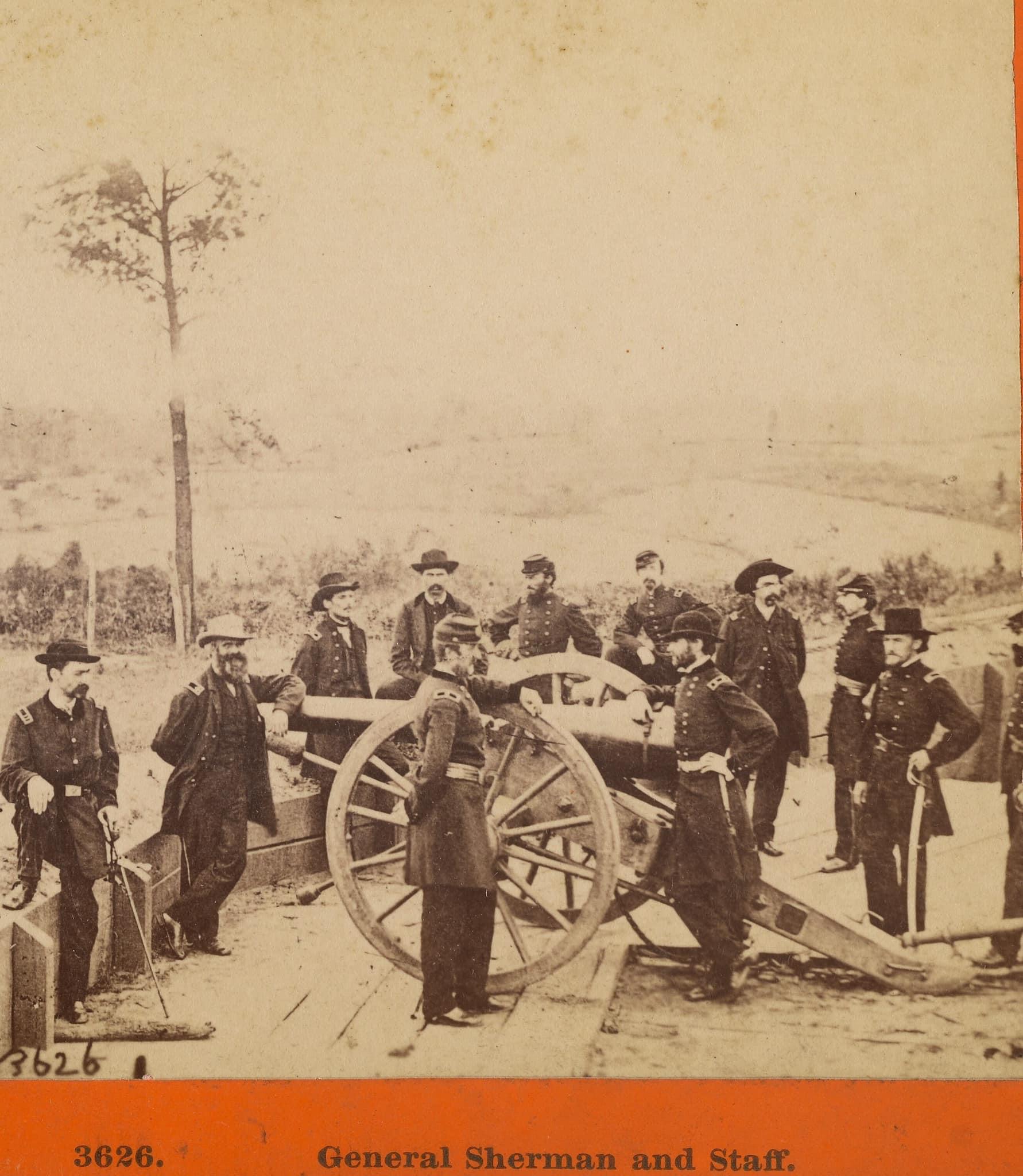
On July 18, 1864, a rare, high‑fidelity archival photograph captured General William Tecumseh Sherman and his senior staff officers at Federal Fort No. 7 on the siege lines outside Atlanta, Georgia. Taken during a pivotal phase of the Atlanta Campaign, the image shows Sherman standing amid earthworks and fallen timber as his army tightened its grip around the city’s defenses. Though the setting was militarily active, the photograph itself was a staged portrait—typical of mid‑19th‑century wet‑plate photography, which required subjects to remain still for several seconds.
The operational reality behind this moment was Sherman’s intense reliance on topographical engineers and field reconnaissance to map the hidden Confederate trench systems before committing his infantry. Sherman frequently used brass field glasses from elevated ridges to observe the movements of General John Bell Hood’s forces, refining his strategy through constant visual assessment of the terrain. The photograph captures the general during this period of meticulous planning, when his command staff worked continuously to interpret Confederate fortifications and determine the next phase of the siege.
The image remains one of the most studied portraits of the Atlanta Campaign. It offers historians a rare glimpse of Union high command operating directly on the front lines, illustrating Sherman’s broader strategic philosophy: victory depended on relentless pressure, precise intelligence, and an unbroken commitment to understanding the battlefield’s geography. The July 18 portrait marks the moment when Sherman finalized the maneuvers that would ultimately lead to the fall of Atlanta and reshape the course of the Civil War.
