
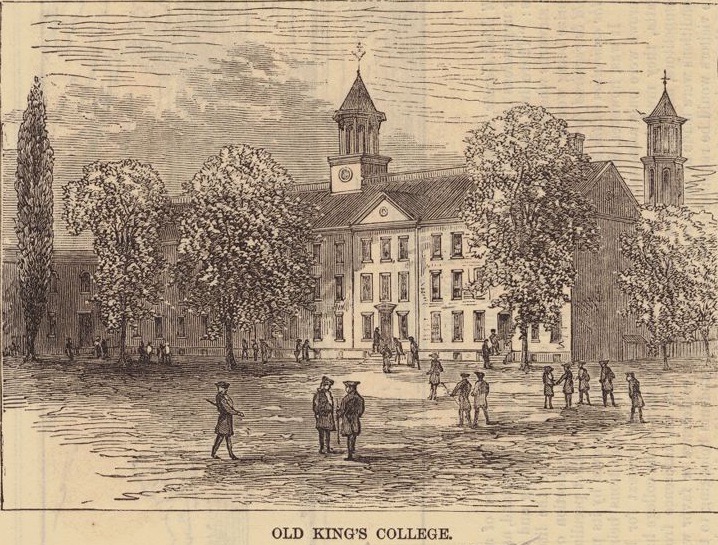
On July 17, 1754, King’s College opened in New York City under a royal charter from King George II, establishing the colony’s premier institution of higher learning. Operating from a modest schoolhouse beside Trinity Church, the academy quickly became an intellectual powerhouse. Years later, on the eve of rebellion, it would draw young men like Alexander Hamilton, John Jay, and Gouverneur Morris—minds whose revolutionary ideas would help shape the nation.
The hidden irony behind King’s College was its original purpose: to serve as a conservative stronghold of loyalty to the British Crown. President Samuel Johnson designed a curriculum steeped in classical languages and Anglican theology to insulate wealthy New Yorkers from the radical democratic ideas spreading through New England. Instead, this rigorous training sharpened the rhetorical tools Hamilton and Jay used to dismantle British legal authority, weaponizing Enlightenment philosophy against their instructors. The school closed during the Revolution, reopened as Columbia College in 1784, and ultimately evolved into Columbia University.
Another overlooked truth is that the institution became a battleground for competing visions of American identity. Loyalist families sent their sons there to preserve the imperial order, while Patriot families increasingly viewed higher education as a weapon against tyranny. The classrooms became ideological crucibles, producing both fierce British loyalists and fiery American revolutionaries—sometimes within the same graduating class.
