
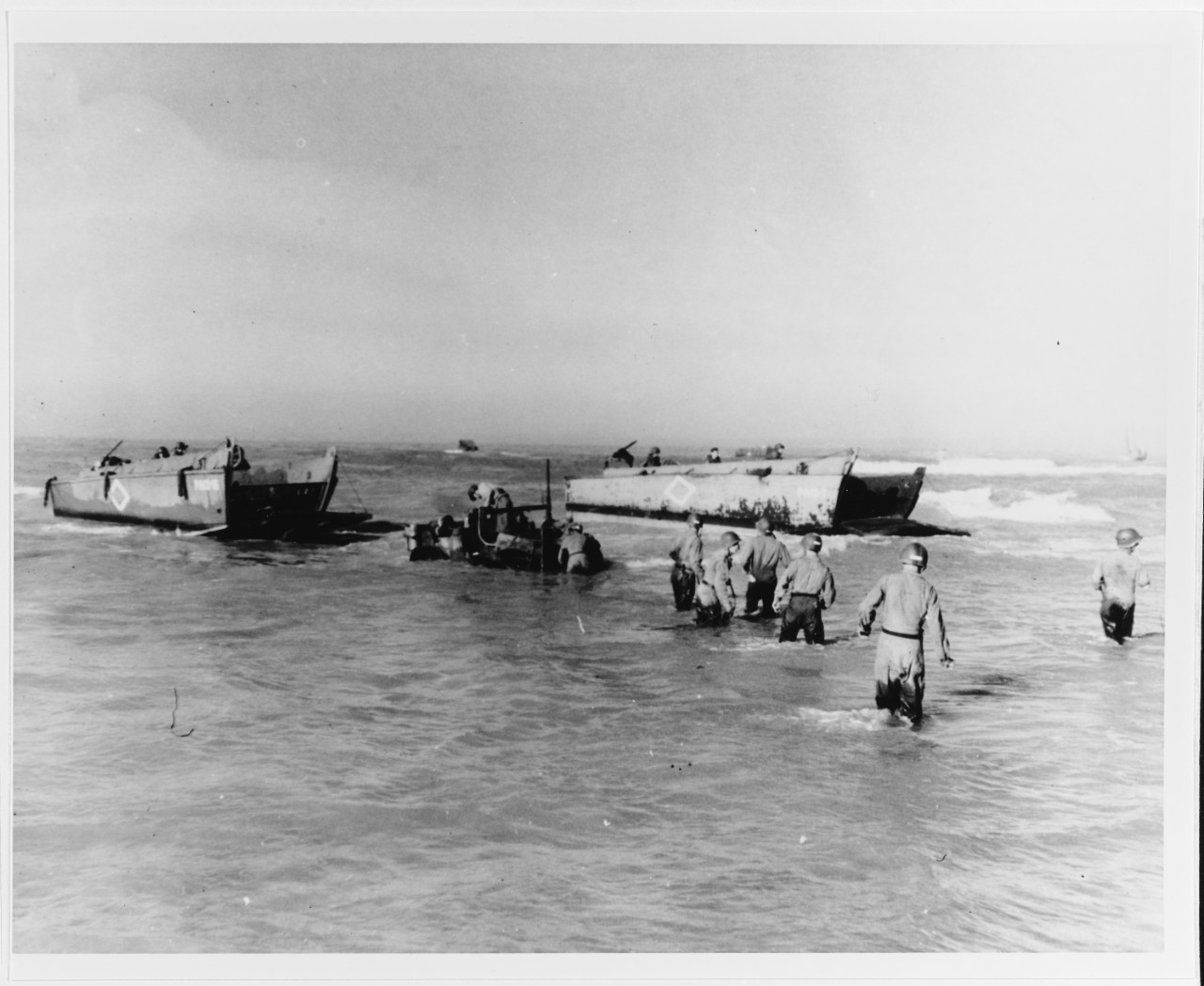
On July 10, 1943, Allied forces launched Operation Husky, a massive, coordinated amphibious assault on the shores of Sicily that opened a critical second front in World War II. The complex campaign involved bitter fighting against entrenched German and Italian forces across rugged, mountainous terrain. For six grueling weeks, Allied troops pushed through fierce resistance to break the Axis hold on the strategically vital Mediterranean island.
The successful operation resulted in a complete victory, forcing a chaotic Axis retreat to the Italian mainland. This pivotal campaign did more than just secure vital territory; it directly triggered the political downfall of Italian dictator Benito Mussolini. By knocking Italy out of the war as a primary player, the invasion altered the strategic landscape of the European theater.
Image: LCVPs from USS Joseph T. Dickman (APA-13) landing vehicles through the surf at Gela, Sicily, during the invasion, with a stalled truck visible in the center, July 10–12, 1943. Photograph from the U.S. Coast Guard Collection in the U.S. National Archives via Wikimedia Commons, public domain.
