
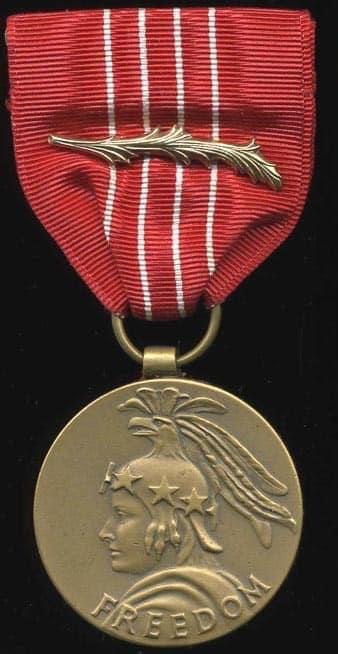
On July 6, 1945, President Harry S. Truman signed Executive Order 9586 officially establishing the Medal of Freedom, a prestigious decoration designed to honor American and foreign civilians who performed exceptionally meritorious service to the United States and its Allies during World War II. Created during the immediate, chaotic aftermath of the Allied victory in Europe, the award provided the federal government with a vital official mechanism to recognize individual acts of non-combat bravery, scientific innovation, and humanitarian assistance that were entirely essential to defeating the Axis powers.
The fascinating distinction of this original 1945 decoration is that it was initially structured primarily as a wartime service award, frequently bestowed upon foreign resistance fighters, civil defense organizers, and intelligence assets who risked execution behind enemy lines to assist the American military effort. This original medal featured a distinct ribbon with three central white stripes, which contrasted sharply with the design of the military decorations, ensuring that civilian contributions to global liberation were elevated to a position of high official prestige.
In 1963, President John F. Kennedy utilized an executive order to completely re-engineer and elevate the decoration, transforming it into the modern Presidential Medal of Freedom, which serves as the nation’s absolute highest civilian honor. Kennedy expanded the scope of the award beyond wartime service to celebrate lifetime achievements in the arts, sciences, public service, and global philanthropy, ensuring its survival into the modern era. Today, while the 1945 design is no longer issued, its creation remains a powerful monument to the millions of everyday citizens who stepped forward during the fires of World War II to preserve the security of the republic.
Photo Source: Hdec CC BY-SA 3.0 via Wikimedia Commons, public domain
Photo Source: Bill Haley and his Comets in 1956 via Wikimedia Commons, public domain
