
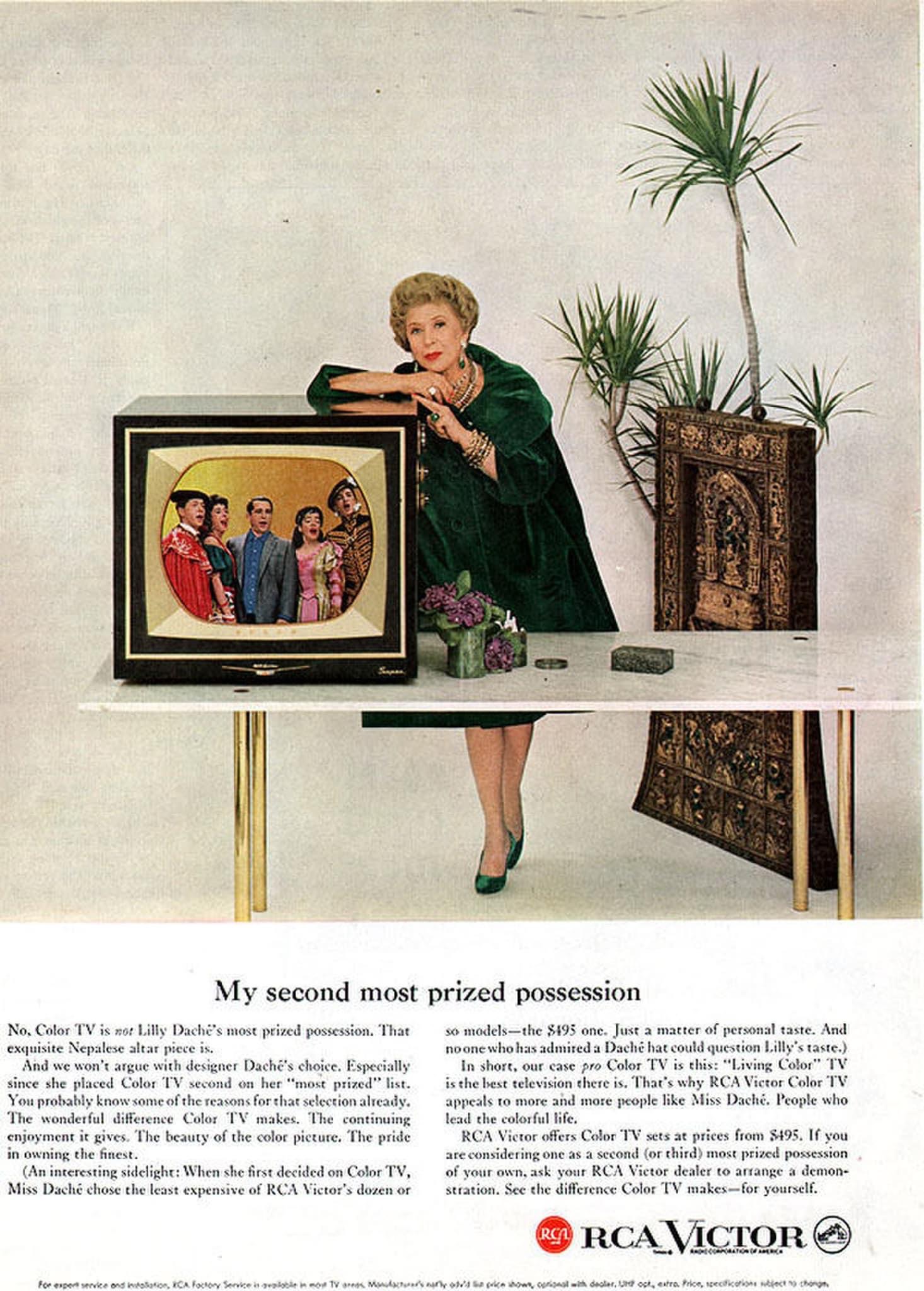
Thirty years prior to the widespread commercial success of home color TV sets, which were heavily advertised by brands like RCA Victor in 1959, the first public demonstration of a color television system took place in New York City on June 27, 1929. Developed by Herbert Ives and his fellow engineers at Bell Telephone Laboratories, this early mechanical system transmitted images of a potted watermelon and a decorative American flag across a short distance, proving that color broadcasting was scientifically viable.
This 1929 system was vastly different from the electronic televisions that would dominate the mid-century market. It relied on a complex mechanical apparatus featuring a rapidly spinning disc perforated with holes, alongside three separate photoelectric cells sensitive to red, green, and blue light. While the resulting image was tiny, flickering, and roughly the size of a postage stamp, it successfully laid the theoretical foundation for all future color transmission technology.
A fascinating element of this demonstration is the hidden motivation behind Bell Labs’ research. They were not trying to invent a home entertainment device for the public; rather, AT&T, Bell’s parent company, was attempting to develop an ultra-futuristic two-way video telephone service. They believed that business executives would pay top dollar to see each other in full color during long-distance corporate calls. The project was eventually shelved because the massive amount of copper wiring required to transmit a color video signal over long distances was economically impossible at the time, accidentally preserving the technology until it could be reinvented for broadcasting.
