
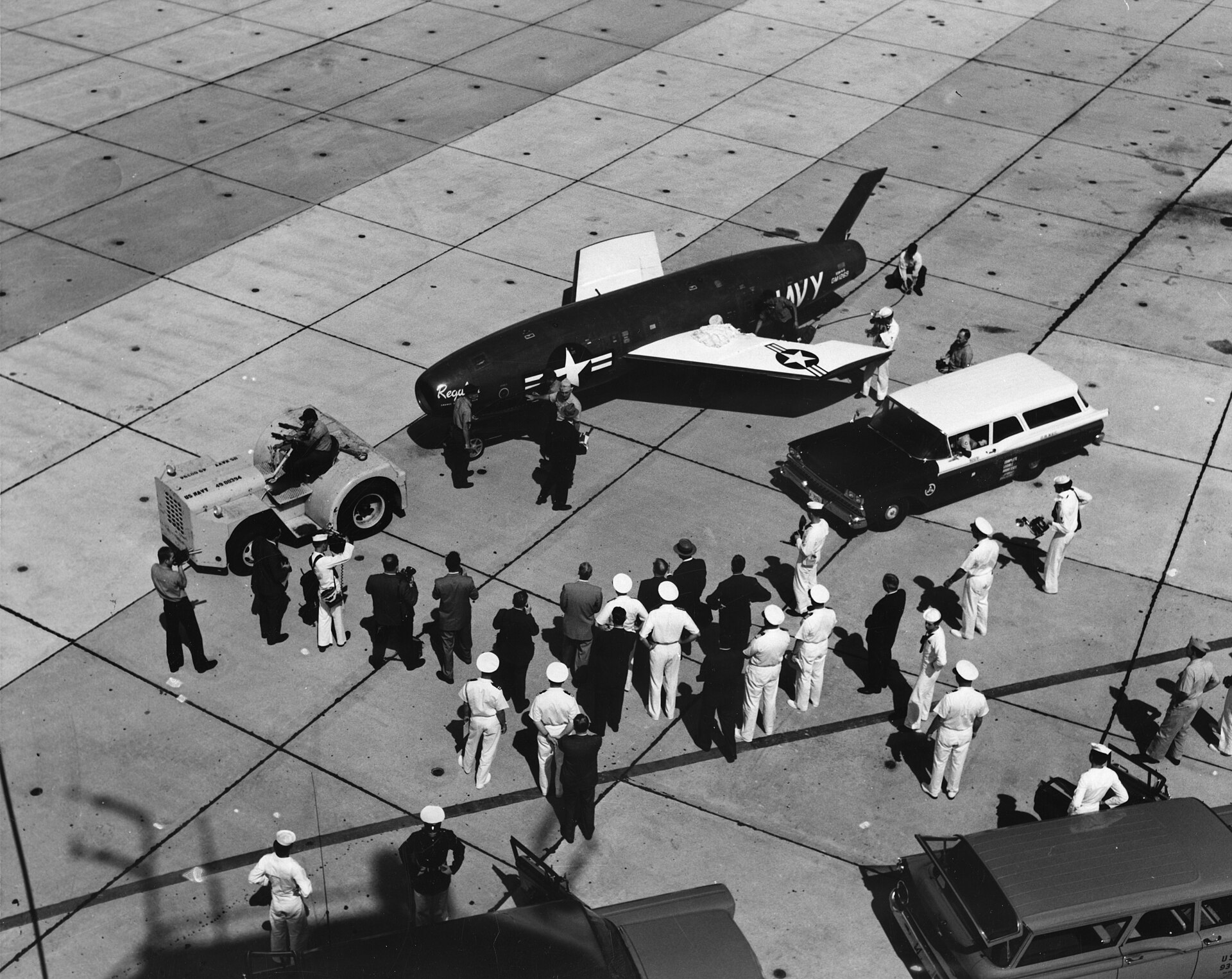
On June 8, 1959, the United States Post Office Department carried out one of the most astonishing delivery experiments in American history by firing a guided missile packed with mail. Off the coast of Florida, the submarine USS Barbero launched a Regulus I cruise missile whose warhead compartment had been replaced with two postal containers holding 3,000 specially prepared letters. The sleek missile streaked across roughly 100 miles of sky before touching down at the Naval Auxiliary Air Station in Mayport just 22 minutes later, where crews opened the nose section to find every letter perfectly intact.
Postmaster General Arthur Summerfield seized the moment with full Cold War bravado. Declaring that “before man reaches the moon, mail will be delivered in hours from New York to California by guided missiles,” he framed the test as a bold preview of a futuristic postal age. Newspapers across the country ran photographs of the missile and its mail cargo, celebrating the feat as a dazzling blend of science fiction and national confidence.
But beneath the spectacle, the flight carried a deeper strategic message. The Regulus I was a nuclear‑capable cruise missile, and this demonstration quietly showcased its accuracy, reliability, and the Navy’s ability to launch such a weapon from a submarine and deliver it precisely to a land‑based target. Though missile mail never became a practical delivery system, for one surreal June afternoon the U.S. postal service stepped directly into the missile age — and sent a subtle but unmistakable signal across the Cold War world.
