
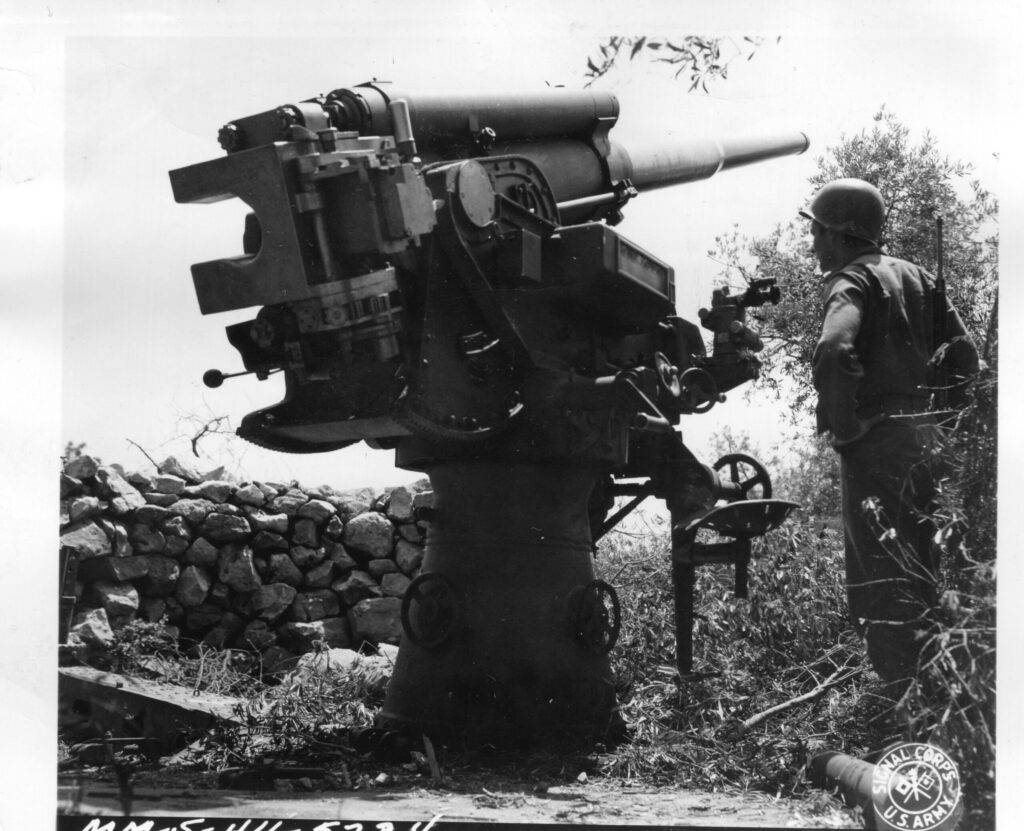
On May 25, 1944, in the immediate aftermath of the Allied capture of Terracina, Sgt. Joe Petrowski of the 337th Infantry Regiment, 85th Infantry Division, examined the precision sights of a massive German 88mm gun. The weapon lay abandoned near the Via Appia corridor, left behind by rapidly retreating elements of the German Tenth Army after the formidable Hitler Line—the last major German defensive position south of Rome—was decisively breached.
Terracina presented a formidable natural bottleneck. Wedged between the rugged Ausoni Mountains and the Tyrrhenian Sea, it was a crucial anchor in the German defensive scheme. The relentless Allied advance, spearheaded by the U.S. Fifth Army, forced the defenders to withdraw, leaving much of their heavy ordnance behind in the narrow coastal passes.
Originally designed as a high-altitude anti-aircraft weapon, the “88” quickly earned a terrifying reputation in ground combat. Its high muzzle velocity and flat trajectory made it arguably the most lethal anti-tank gun of the war. Throughout the grueling Italian Campaign—from the fortified slopes of Monte Cassino to the Anzio beachhead—these concealed guns dominated the hillsides, exacting a heavy toll on Allied armor.
For soldiers like Sgt. Petrowski, finding such a dreaded weapon silenced and abandoned was a tangible sign of shifting momentum. The fall of Terracina effectively linked the forces breaking out from Anzio with the armies pushing up from the south, clearing the ancient road to Rome and marking a pivotal turning point in the liberation of Italy.